
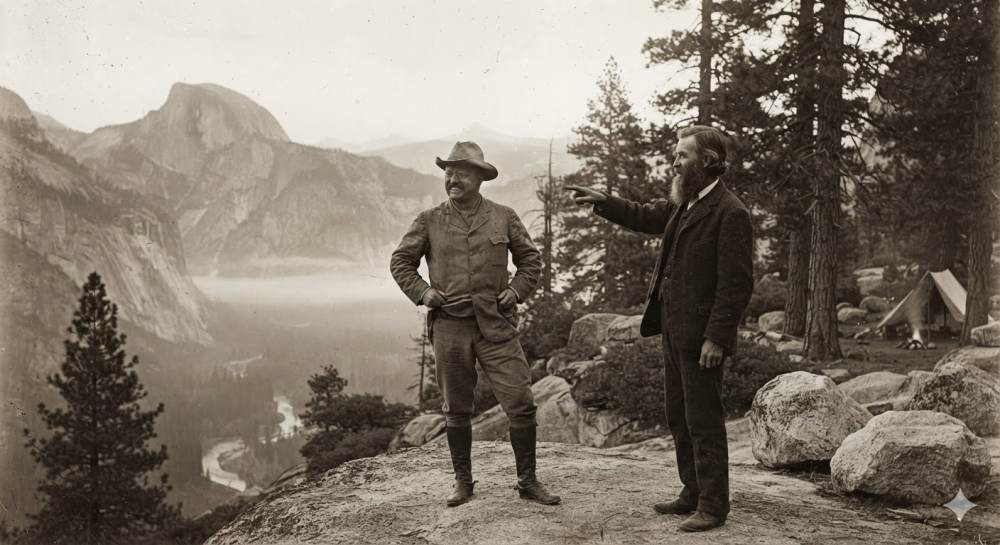
Theodore Roosevelt is widely considered America\’s Conservation President, placing approximately 230 million acres of public land under federal protection during his presidency from 1901 to 1909. While he did not establish the National Park Service itself, which was created in 1916, his aggressive executive actions and legislation laid the structural foundation for the modern U.S. parks and public lands system.
The Antiquities Act of 1906
The single most powerful tool Roosevelt used was the Antiquities Act of 1906.
- Executive Power: This law gave the president authority to bypass Congress to protect federal lands as national monuments.
- Fast-Tracked Protection: Roosevelt used it to proclaim 18 national monuments, including Devils Tower, Muir Woods, and Petrified Forest.
- Saving the Grand Canyon: When Congress stalled on protecting the Grand Canyon, Roosevelt used the act to declare it a national monument in 1908, protecting it from mining and commercial development until it later became a national park.
National Parks Established by Roosevelt
Though often associated with all parks, Roosevelt directly signed legislation establishing five new national parks:
- Crater Lake National Park (Oregon, 1902)
- Wind Cave National Park (South Dakota, 1903)
- Sullys Hill National Park (North Dakota, 1904 \— later converted to a wildlife refuge)
- Platt National Park (Oklahoma, 1906 \— now part of Chickasaw National Recreation Area)
- Mesa Verde National Park (Colorado, 1906)
The Broader Public Lands Legacy
Roosevelt\’s conservation efforts extended far beyond national parks, aggressively shifting millions of acres into federal management:
- U.S. Forest Service: Established the U.S. Forest Service in 1905 with Gifford Pinchot, creating 150 national forests covering roughly 150 million acres.
- Wildlife Refuges: Created the Federal Bird Reserve system\—the predecessor to today\'s National Wildlife Refuge System\—beginning with Pelican Island, Florida in 1903 to protect birds from the fashion industry. He created 51 bird reserves and 4 national game preserves.
The Camping Trip that Changed Yosemite
In 1903, naturalist John Muir invited Roosevelt to a three-day camping trip at Glacier Point in Yosemite. Sleeping on the ground under giant sequoias, Muir convinced the president that California was not doing enough to protect the Yosemite Valley. Deeply moved, Roosevelt later pressured the state to cede control of the land back to the federal government, ensuring the entire valley was permanently protected under unified federal national park status in 1906.
Theodore Roosevelt National Park Today
Ironically, the only national park named directly after a person is Theodore Roosevelt National Park in the badlands of western North Dakota.
It preserves the very rugged landscapes where Roosevelt ranched, hunted bison, and healed from the tragic deaths of his wife and mother in 1884. It was in these badlands that he developed the strenuous outdoor philosophy and conservationist ethos that later transformed the American landscape.