
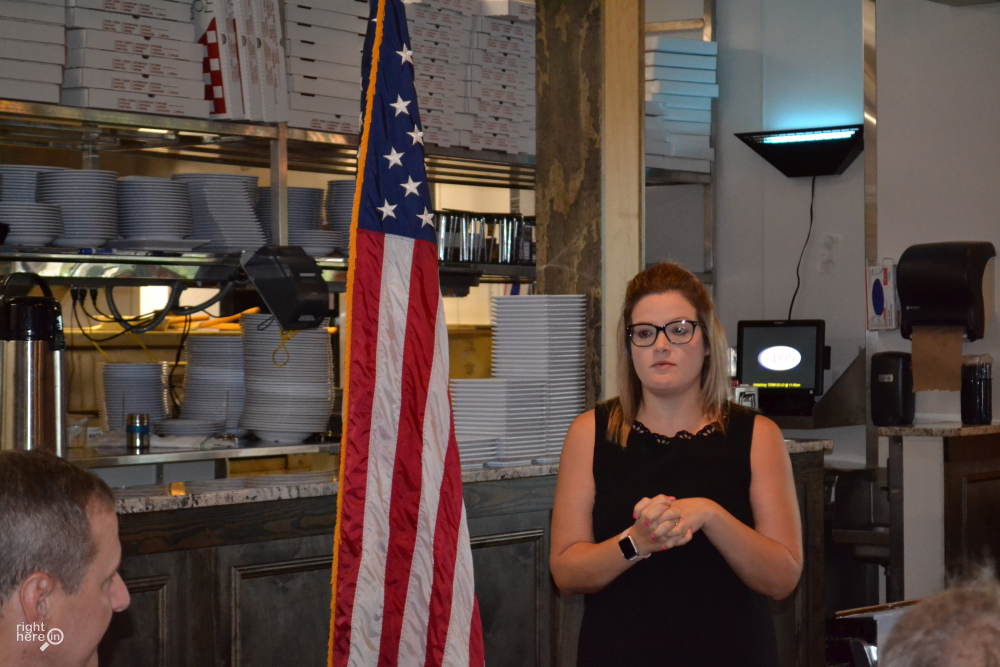
On Tuesday morning, July 18, the\ Sunrise Rotary Club of Apex\ met and had as their speaker a very dynamic individual with a purity of cause. That individual is\ Kate Beale,\ MSW, Hospital Development Specialist, Carolina Donor Services. She spoke on the need for us to all consider the importance of signing a donor card and making sure it is noted on your driver\’s license.
Kate was kind enough to provide some point for you to consider. \“There are currently over 117,000 people awaiting a lifesaving organ transplant. There are not enough organs available; currently 22 people die every day while waiting. One organ donor can save the lives of up to\ 8 people, one tissue donor can impact the lives of over 75 people and one cornea donor can give vision to 2 people.\”
You can designate your wishes to be a donor by:
- Saying YES at the DMV
- Registering online @\ www.donatelifenc.org
- Visiting the HealthApp on\ your iPhone/Apple device.
- Lastly, always share your wishes with your family.
If you would like additional information or to arrange for Kate Beale, MSW to come and talk to your group of organization she can be reached at:
Kate Beale, MSW,\ Hospital Development Specialist
Carolina Donor Services
3621 Lyckan Parkway, Durham, North Carolina 27707
Phone: 919-412-4093\ \
kbeale@carolinadonorservices.org
 The following Myth/Fact information is extracted from\ a very informative website on \“Donate Life\” for your consideration www.organdonor.gov/index.html\ \ .
Myth: I have a medical condition, so I can\'t be a donor.
Fact: Anyone, regardless of age or medical history, can sign up to be a donor.\
The transplant team will determine at an individual\'s time of death whether donation is possible.
There are very few conditions that would prevent a person from becoming a donor\—such as HIV infection, active cancer, or a systemic infection. You should still consider registering. Even with an illness, you may be able to donate your organs or tissues.
Myth: I\'m too old to be a donor.
Fact: There\'s no age limit to organ donation.\
To date, the oldest donor in the U.S. was age 93. What matters is the health and condition of your organs when you die.
Myth: I don\'t think my religion supports donation.
Fact: Most major religions in the United States support organ donation and consider donation as the final act of love and generosity toward others.\
For more about religion and organ donation,\ check here.
Myth: If they see I\'m a donor at the hospital, they won\'t try to save my life.
Fact: When you are sick or injured and admitted to a hospital, the one and only priority is to save your life.\
Period. Donation doesn\’t become a possibility until all lifesaving methods have failed.
Myth: Rich or famous people on the waiting list get organs faster.
Fact: A national computer system matches donated organs to recipients.\
The factors used in matching include blood type, time spent waiting, other important medical information, how sick the person is, and geographic location. Race, income, and celebrity are NEVER considered.