
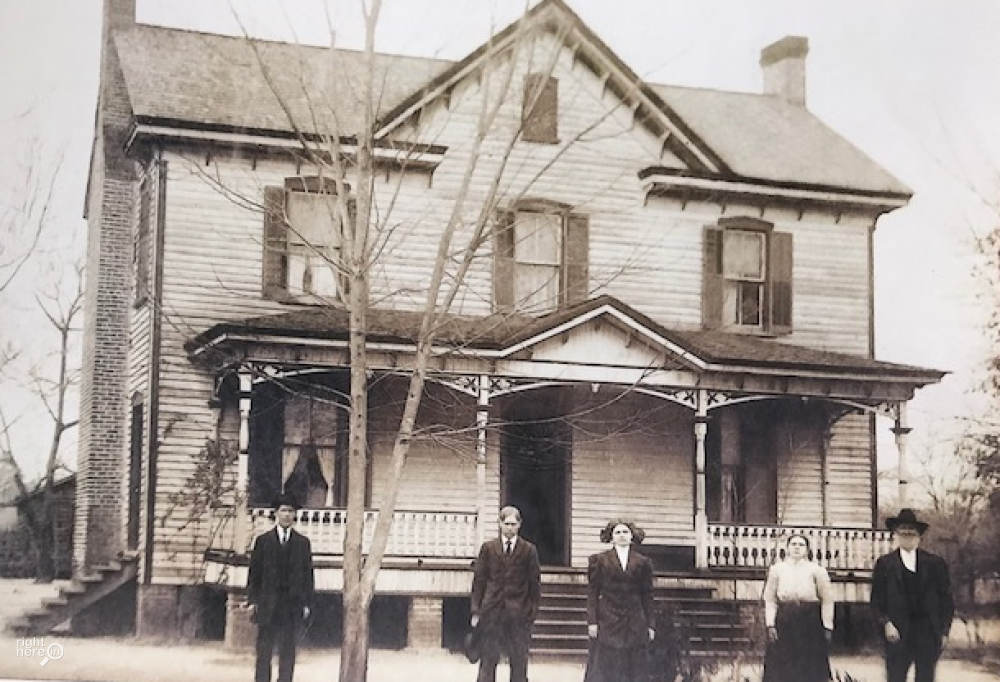
Submitted by Willa Akins Adcock
A few years ago, Teresa Leonard, N\&O staff writer did some research on an article \“Past Times\”. \ Her information was taken from writer Ben Dixon McNeill who wrote about the importance of the long-leaf pine in North Carolina and other Southern States. \ Having known that my grandfather\’s home in Willow Spring was built in 1900 with the last of the long-leaf pine in that area, I found the article interesting.

I was aware that foresters today were encouraging landowners to plant Long-Leaf Pines. \ There is a subsidy for those who do. \ What I didn\’t understand was the demise of the turpentine industry and the fact that North Carolina was stripped bare of its heart-pine timber for so long. \ Much of the timber was used for construction around the turn of the 20th Century but had not been replenished.\

In the spring of 1900, my grandfather, John Quinton, \“Quint\”, Adams, Sr\’s. home burned. \ This resident had been built in early 1870. \ Grandpa had used the home for a school for a number of years before he married Annie Eliza Blalock, April 1, 1878. \ At the time of their marriage, Quint was 32 and Annie Eliza was 22. \ By the time of the fire they had 6 children all living at home.

The fire started at night from the kitchen some distance from the main dwelling. \ The sparks from the kitchen caught the wooden shingles of the two-story structure ablaze. \ All efforts to extinguish the fire failed. \ Neighbors came to help, but they could not get water to the roof fast enough. \ Soon they saw they were fighting a losing battle. \ They started removing furniture from the main house; sparks would fall on the items, and they would have to move them farther from the burning residence. \ Soon the house was completely engulfed; totally destroyed by the flames except for the chimneys.
On Monday morning after the fire on Saturday night, the neighborhood men met at the burned-out sight. \ They came to offer help and discuss plans for the day. \ Before they could start, my grandmother, Annie Eliza, called for prayer. \ She thanked God that they were all safe, and she thanked God that the men had come to offer help; next asking for courage in the days ahead!
These men with my grandmother\’s brother, Jack Blalock, moved a cotton storage house up to the kitchen chimney that was left standing. \ This would enable the family to use the fireplace for cooking. \ The other end of this cotton house would be used for \“Quint\’s\” and Annie Eliza\’s bedroom.
The men then built a little shed onto this temporary home that was now in place where the kitchen had stood; making the cotton house two rooms. \ This little shed was where the two girls slept. \ The four boys slept in another cotton house nearby.
Grandpa \“Quint\” couldn\’t rebuild that spring because it was cotton-planting time when the fire occurred. \ Early the next year, 1901, the house was rebuilt to look much like the original dwelling except for two gables that were added\—one on the roof of the two-story section, and the other on the porch.
The house still stands today, though remodeled with additions, along Hwy. 42 about 3 miles east of Willow Spring. \ The present home faces John Adams Road.
My grandmother, Annie Eliza, had inherited from her father, Hugh Blalock, just the year before the fire, a tract of timber containing the last of the Long-Leaf Pine in the area. \ Those pines were cut for the construction of the new house.\
Annie Eliza\’s brother, William \“Bill\” Blalock, who operated a saw mill processed all the lumber that was used in the framing of the new house; this was all heart pine. \ Uncle \“Bill\” offered his services to his sister\’s family for free.
The finished lumber for the floors and moldings was purchased from Brigg\’s Hardware in Raleigh. \ My grandfather figured the house, almost 4,000 sq. feet, cost a total of $500. \ He didn\’t have to buy the lumber for framing or pay for the sawmilling; just the cost of construction and hardware.
Mr. Davis who built the original house, and also this structure, was paid $170 dollars for the labor. \ His helpers were probably only paid .50 cents a day. \ That how prices were in 1901.
I was aware that foresters were encouraging landowners to plant long-leaf pines today. \ There is even a subsidy for those who do. \ What I didn\’t understand was the demise of the turpentine industry and the fact the North Carolina was stripped bare of its heart-pine timber for so long. \ So much of the timber had been used for construction around the turn of the 20th Century, but it had not been replenished.
Two things contributed to the demise of the industry. \ The trees were bled to death extracting the turpentine. \ The producers and consumers discovered that there was no difference between the trees in NC and the trees in other parts of the South. \ The end of the 19th Century saw, too, and enormous increase in the demand for long-leaf pine lumber.

Within 20 years the forest, already bled white under the hacks of the turpentine operators, succumbed finally to the axes of the lumbermen. \ NC was stripped bare of its long-leaf timber.
It was during this time that my grandfather\’s home was rebuilt using the last of the long-leaf pine in that area. \ I realize how blessed they were to have access to this type of lumber. \ With foresters encouraging the planting of long-leaf pine today, perhaps future generations will avoid the mistakes of the past. \ The pine tree bill was passed February 27, 1963 making the pine tree the North Carolina State Tree.
ISAIAH 13 \“The glory of Lebanon will come to you, the pine, and the fir together to adorn the place of my sanctuary.\”
\