By Willa Akins Adcock
Historical background of Fuquay-Varina
The Fuquay-Varina area first known as \‘Piney Woods\’, over time, became known as \‘Varina\’; sometime later the town adopted the name Fuquay Springs. \ William Fuquay, a Frenchman, purchased 1,000 acres of land in the area for $500 from the Lord\’s Proprietors of England.\ One of William\’s descendants is credited with the name Fuquay; the name Varina arises from a love story ascribed to J. D. \‘Squire\’ Ballentine.\ Beginning in the middle of 1800, the importance of a MINERAL SPRING began to flow deeply through both areas of Main Street and Broad Street.
Until the late 19th Century, the area now known as Fuquay-Varina was little more than a crossroads community with a locally-popular MINERAL SPRING discovered in the mid 1800 by farmer, David Fuquay.\ He discovered the SPRING on his land in Middle Creek Township of southern Wake County as early as 1858.\ The SPRING was modestly developed as a resort by Parson McCoy, Billy Sexton, and Cornelius Harnett Cofield.
The Fuquay Mineral Spring Corporation was founded in 1890 to market and develop the SPRING for its reputed medicinal properties.\ In 1902 the SPRING was named FUQUAY SPRINGS in honor of the original owner of the land, and development around it began to take place.
Plowing his fields one day, Stephen Fuquay, the great-grandson of William Fuquay, the Frenchman, unearthed an effervescent SPRING of crystal clear WATER.\ He came to believe that this vibrant SPRING had medicinal properties.\ Stephen Fuquay spread the word, and the supposed curing effects of this BUBBLING WATER quickly became known far and wide.
Sometime after the SPRING\’S discovery, J. D. Ballentine of the region enlisted in the Civil War.\ It was the custom of the day for young ladies to write letters of support to soldiers on the battle field.\ Ballentine began receiving letters signed \‘Varina\’ from Virginia Arey of Fayetteville; he continued to receive these letters while in service.\ The name, \‘Varina\’, that Virginia Arey had adopted, was possibly taken from Varina Davis, wife of Jefferson Davis President of the Confederacy.\ After the Civil War, Ballentine searched for his \‘Varina\’ and found her; falling in love, they soon married.\ He persisted in calling her Varina; she continued to use that name as well.
Ballentine in the late 1800\’s began a school overlooking the SPRING. \ Later as a result, he became known as \‘Squire\’ Ballentine.\ He also opened a post office and a mercantile company, that he both named \‘Varina\’ near the popular SPRING.\
In 1900 with the SPRING at its peak, John A. Mills, a lumberman who used the railroad to transport his loads, began equipping his railcars for \‘Moonlight Excursions\’ to the area. \ Tourist came from all over to take \‘THE WATERS\’.\ \
In 1902 with affirmation to Stephen Fuquay\’s celebrated SPRING, the post office located near the SPRING with the name \‘Varina\’ was renamed \‘Fuquay Springs Post Office\’.\ Yet, incorporation of the town of Fuquay did not come until 1909.
My parents, Herbert Akins from Holly Springs, and my mother, Annie Mae Adams of Willow Spring, first met at the SPRING in 1910.\ \ Mother had this to say: \“Everyone wanted to be at the SPRING and drink the WATER; some even purchased \‘Jimmy Jugs\’ of this MEDICINAL WATER to take home. \ Soon hotels and boarding houses were built to accommodate the crowds.\ The popularity of the SPRING, with the help of the railroad, continued to bring large crowds to the area.\ You did not want to miss being at the SPRING; on Easter and the Fourth of July.\ This was a special time to see friends and meet new ones.\” \ \
After my mother graduated from Cary Boarding Academy and my Dad returned from WWI, they were married and lived on Broad Street in the Varina district of town. \ My mother often talked about the pleasant memories of visiting the SPRING, and meeting so many as well as my dad there.
Later the Broad Street district along with the railroad junction established its own post office.\ This area known as Broad Street adopted the name \‘Varina\’ that had been discarded by the Main Street district.\ This neighborhood, called Varina, just two miles north of the SPRING, did not incorporate.\ However, it was at this depot that many tourists disembarked for the SPRING. These travelers found lodging in the area pursuing the important \‘HEALTH-GIVING WATERS\’.
As my mother would say: \“In the early 1900, southern Wake County began experiencing a new kind of growth.\ Tobacco farmers, with their \‘high stepping horses\’ thinking they were better than the locals, migrated to the Fuquay area from Granville County and other near-by areas to escape a condition known as \‘Grandville Wilt\’.\ This disease had been devastating their crops.\ These transplanted farmers saw their tobacco thrive in the area.\ Local farmers took notice; they began to realize that tobacco was producing more income than cotton.\”
Fields of cotton were soon replaced with tobacco. \ Warehouses were built to auction the \‘Golden Leaf\’, and better employment opportunities became available.\ On June 1st, 1963, the two prospering communities incorporated as one municipality combining the names with a \‘hyphen or dash\’ to become Fuquay-Varina.
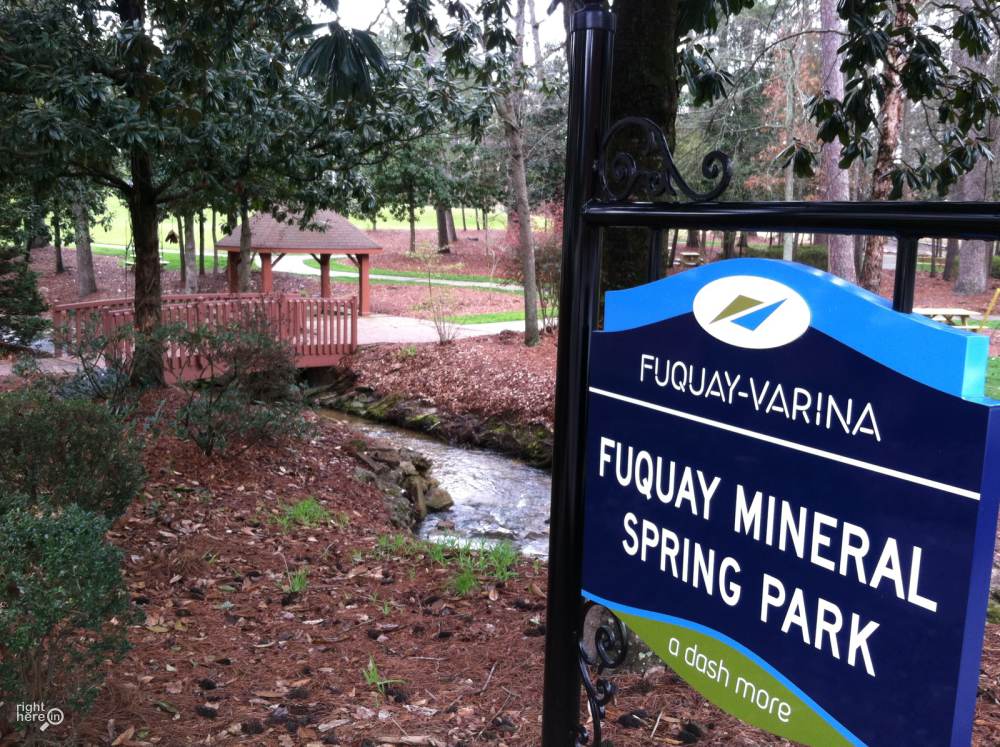
In 2011, the private property on which the SPRING was first discovered was purchased by the town.\ The block on South Spring Avenue and West Spring Street, where the \‘HISTORIC SPRING\’ continues to flow welcomes locals as well as visitors.\ These grounds have become a lovely park with paved walks and pleasant surroundings.\ The relaxing WATERS of the beloved SPRING have become a tranquil respite proving that the area is both mystical as well as a source of healing.
If you are a new arrival in the area, we welcome you to Fuquay-Varina; the town that has become a \‘dash\’ more. \ You, too, will benefit from this hallowed area where the \‘MUCH CELEBRATED SPRING\’ still flows.
Isaiah 49:10 \‘The God Who has compassion on them will guide them and lead them besides SPRINGS OF LIVING WATER.\’
Some information in this article was taken from the Historical Research Library at Campbell University. Other insight was taken from a recording of my mother, Annie Mae Adams Akins of Willow Spring, who visited the SPRING often as a young lady.\ She died in 1985 at age 94.