
These colorful summer flowers thrive in the garden without a lot of watering.\ \ Masses of colorful summer flowers bring undeniable cheer to a gardener. A skyrocketing water bill? Not so much. But there are plenty of flowers that can handle the summer heat without\ demanding you water them all the time. Like all plants, they\'ll need more frequent watering while they are young, but once these summer-blooming beauties are established, you can keep the hose wound up most days or even take a vacation and the flowers will keep coming.
Silvery foliage contrasts with vibrant flowers in\ African daisy\ (Arctotis\ spp.)\ plants.\ If you live in a mild climate, African daisies will do fine without an abundance of water (in high heat, the flower will close up and require more water).
The tall, nectar-producing flowers of\ anise hyssop\ (Agastache foeniculum) will draw pollinators aplenty to your summer garden. Both the foliage and colorful flowers of this perennial also add delightful fragrance.
A garden staple for good reason, drought-tolerant\ black-eyed Susan\ (Rudbeckia\ spp.)\ bring the color from midsummer all the way through fall, when many other flowers fade. They come in both annual and perennial varieties.
The blooms just keep coming when you plant a\ blanket flower\ (Gallardia\ spp.) in your garden. Native to American prairies, the plant can handle poor soil and drought, making it an especially good option for\ rock gardens.
The vibrant blue flowers of\ borage\ (Borago officinalis)\ aren\'t just striking in\ an herb garden\—they\'re edible too. Toss them into salads, drinks, or desserts.
For summer flowers that look otherworldly, try\ celosia. Some look like small flames, others like candles, and still others like ocean coral. But all love the heat, and most varieties are drought tolerant.
With their long, colorful petals and distinctive cone-shaped centers,\ coneflowers\ (Echinacea\ spp.) are irresistible to both gardeners and pollinators. The perennial comes in single and double varieties, and in colors ranging from hot reds and oranges to cool pastel pink.
For a plant that is sure to thrive without a lot of fuss, it\'s hard to beat\ catmint\ (Nepeta\ spp.). These hard-working perennials bloom with pretty purple flowers even in poor soil, and are\ rarely bothered by deer\ or pests.
The bright flowers of\ coreopsis\ herald the beginning of summer\—and the plants keep on blooming all season long through heat and humidity.\ Deadhead the flowers\ regularly to encourage more buds to form, but be sure to leave a few flowers on the plant\—birds love their seeds.
Cosmos\ may look delicate on their thin stems, but the plants don\'t actually require much fuss\—in fact, these annuals stand up well to dry conditions once they\'re established. Breeders have played up the romance of this flower, creating single, semi-double, and fully double in a variety of pretty hues.
Mid-summer is when the flowers of\ daylilies\ (Hemerocallis\ spp.)\ make their debut, unfurling gorgeous petals in a huge spectrum of colors and\ shapes from spider to ruffled. These fast-growing perennials are surprisingly resilient and handle drought well.
Dianthus\ may be best known as a spring flower, but breeders have produced many cultivars that can handle the heat of summer without a ton of water too. Varieties range from\ tough groundcovers\ to taller varieties that are perfect for vases.
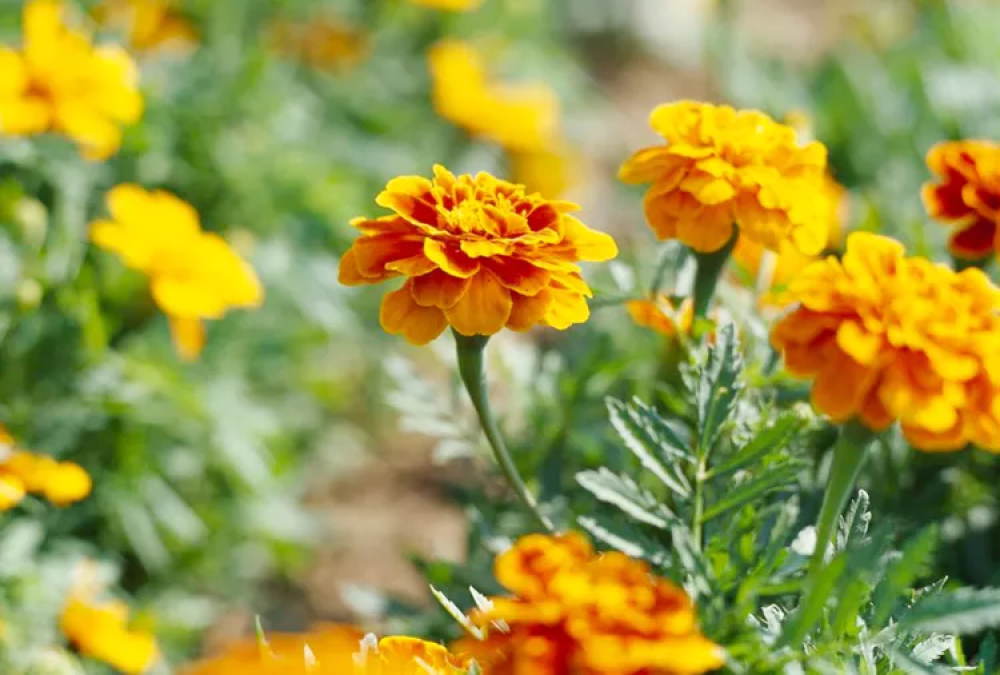
As companions in a vegetable beds or showcased in a pot,\ French marigolds\ (Tagetes patula)\ evoke the bright and sunny days of summer. The annuals\—available in double, pom-pom, and single-petaled varieties\—grow easily from seed, and do well without much water once they\'re established.
At the end of a long day, the cheerful flowers of pink\ evening primrose\ (Oenothera speciosa) is a welcome sight. The fragrant, cupped flowers open white and mature to pink. Though this is a native perennial, the plants tend to spread easily (in some areas, quite aggressively) so site it where it can sprawl.
Globe amaranth\ (Gomphrena globosa)\ produces tiny white flowers, but its stiff, bright magenta bracts are what really stand out in gardens or in vases. An annual in most places (though it can grow as a short-lived perennial in Zones 2-8), globe amaranth will bloom even in drought conditions from summer through fall.
There are plenty of reasons\ geraniums\ (Pelargonium\ spp.) adorn so many gardens, pots, and\ window boxes\—they don\'t just produce colorful flowers in summer, but hold up in hot, low-water conditions too. Of the various types of geraniums, zonal varieties do best in the heat.
There are more READ HERE
\