
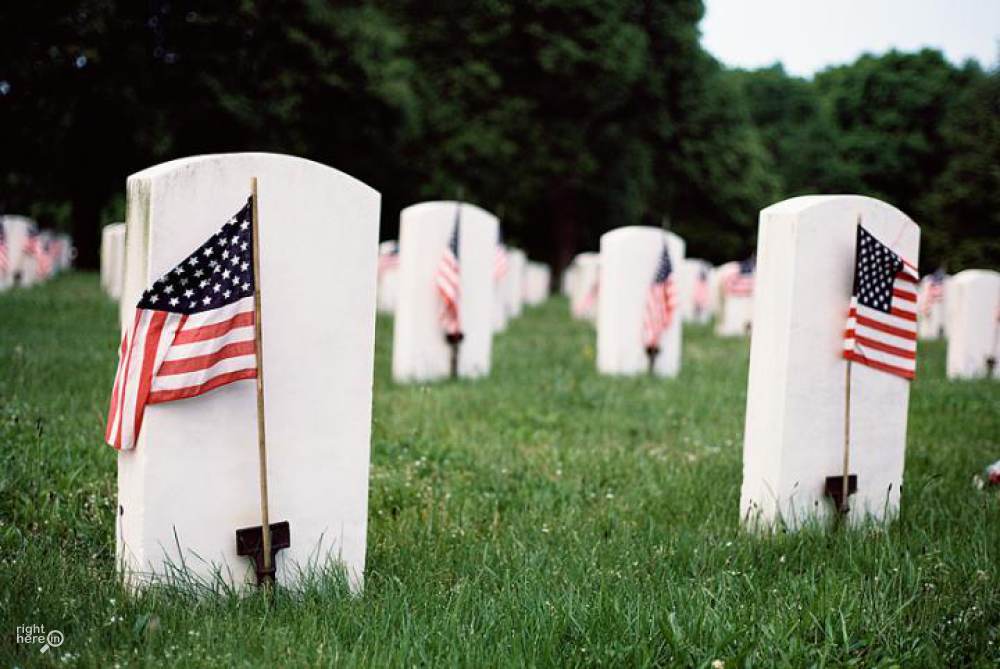
Memorial Day, is a day of remembrance for those who have died in service of the United States of America. Memorial Day was borne out of the Civil War and a desire to honor our dead.\
On both Memorial Day and Veterans Day, it\’s customary to\ spend time remembering and honoring the countless veterans who have served the United States\ throughout the country\’s history. However, there is a distinction between the two\ holidays:
- Memorial Day\ commemorates the men and women who\ died\ while in the military service of their country, particularly those who died in battle or as a result of wounds sustained in battle. In other words, the purpose of Memorial Day is to memorialize the veterans who made the\ ultimate sacrifice\ for their country.\ We spend time remembering those who lost their lives and could not come home, reflecting on their service and\ why we have the luxury and freedom that we enjoy today. We might consider how we can support and safeguard their grieving\ families and loved ones who are left behind.
\ - Veterans Day\ is the day set aside to thank and honor\ ALL\ who served\—in wartime or peacetime\—regardless of whether they died or survived.\ Veterans Day is always observed officially on November 11, regardless of the day of the week on which it falls.\
Traditionally, on Memorial Day (U.S.), people visit cemeteries and memorials, and volunteers often place American flags on each grave site at national cemeteries.\ A national moment of remembrance takes place at 3:00 p.m. local\ time.
The custom of honoring ancestors by cleaning cemeteries and decorating graves is an ancient and worldwide tradition, but the specific origin of Memorial Day\—or\ Decoration Day, as it was first\ known\—is\ unclear.
In early rural America, this duty was usually performed in late summer and was an occasion for family reunions and picnics. After the Civil War, America\’s need for a secular, patriotic ceremony to honor its military dead became prominent, as monuments to fallen soldiers were erected and dedicated, and ceremonies centering on the decoration of soldiers\’ graves were held in towns and cities throughout the\ nation.
After World War I, the day expanded to honor those who have died in all American\ wars.
WHY IS THE POPPY A SYMBOL OF MEMORIAL\ DAY?
In the war-torn battlefields of Europe, the common red field poppy\ (Papaver rhoeas)\ was one of the first plants to reappear. Its seeds scattered\ in the wind and sat\ dormant in the ground, only germinating\ when\ the ground was disturbed\—as it was by the very brutal fighting\ of World War\ 1.

John McCrae, a Canadian soldier and physician, witnessed the war first hand and was inspired to write the now-famous poem \“In Flanders Fields\” in 1915. (See below for the poem.) He saw the poppies scattered throughout the battlefield surrounding his artillery position in\ Belgium.
The Poppy\ Lady
In November 1918, days before the official end of the war, an American professor named Moina Michael wrote her own poem, \“We Shall Keep the Faith,\” which was inspired by McCrae\’s \“In Flanders Fields.\” In her poem (also shown below), she mentioned wearing the \“poppy red\” to honor the dead, and with that, the tradition of adorning one\’s clothing with a single red poppy in remembrance of those killed in the Great War was born. Moina herself came to be known\—and honored\—as \“The Poppy\ Lady.\”
The Symbol Spreads\ Abroad
The wearing of the poppy was traditionally done on Memorial Day in the United States, but the symbolism has evolved to encompass all veterans living and deceased, so poppies may be worn on\ Veterans Day\ as well. Not long after the custom began, it was adopted by other Allied nations, including Canada, Australia, New Zealand, and the United Kingdom, where it is still popular today. In these countries, the poppy is worn on Remembrance Day (November\ 11).
Today, poppies are not only a symbol of loss of life, but also\ of recovery and\ new life, especially in support of the servicemen who survived the war but suffered from physical and psychological injuries long after it\ ended.\
\“In Flanders\ Fields\”
by John McCrae, May\ 1915
In Flanders fields the poppies blow
Between the crosses, row on row,
That mark our place; and in the sky
The larks, still bravely singing, fly
Scarce heard amid the guns\ below.We are the Dead. Short days ago
We lived, felt dawn, saw sunset glow,
Loved and were loved, and now we lie
In Flanders\ fields.Take up our quarrel with the foe:
To you from failing hands we throw
The torch; be yours to hold it high.
If ye break faith with us who die
We shall not sleep, though poppies grow
In Flanders\ fields.
Remember: Express your thankfulness and honor to those who continue to serve and raise the flag with honor and respect.