
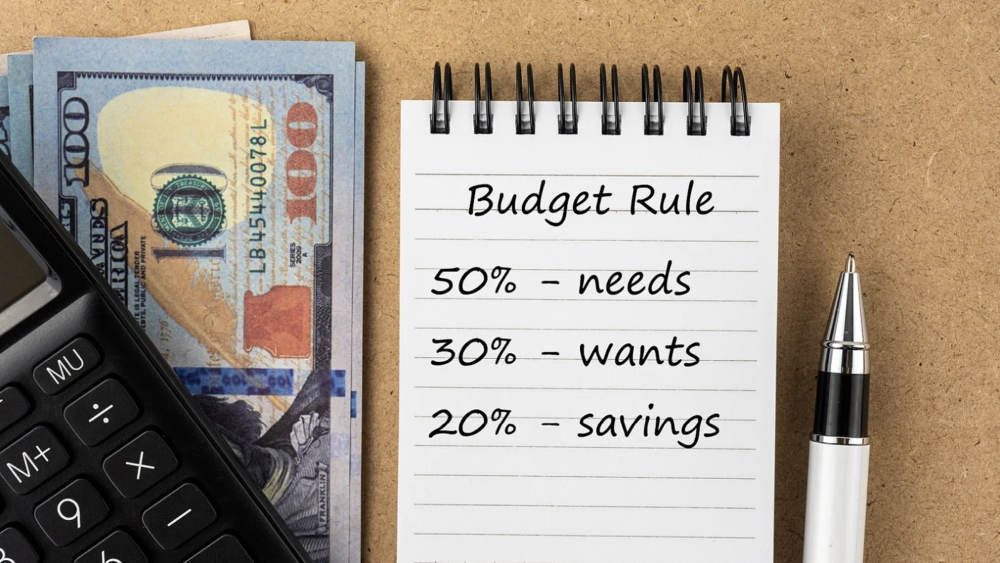
Looking for a straightforward budget that helps you save money and more effectively manage your finances? Consider the 50-30-20 budget rule. This budgeting tactic is a great first step for anyone looking to better manage their money. It keeps things simple while helping you prioritize saving and paying off debt. \
Using the 50-30-20 rule can help you determine exactly where your money is going each month, which in turn helps you make changes in your spending. Here\'s what you need to know about the 50-30-20 budget rule.\
What is the 50-30-20 budget rule?
The 50-30-20 rule is a form of budgeting that splits your monthly, after-tax income into three major categories: necessities, wants and savings. \
50% \— necessities
When following the 50-30-20 budget, you\'ll start by allocating 50% of your income towards necessities. These are expenses that you just can\'t avoid, such as:
- Housing\
- Utility bills
- Food\
- Transportation\
- Child care\
- Insurance (car, home, life)\
30% \— wants
Let\'s face it, life would be miserable if you didn\'t have a few splurges every once in a while. Luckily, with the 50-30-20 budget, you\'ll allocate 30% of your take-home income towards wants. This category obviously includes all non-essential purchases, such as:\
Subscription streaming services, such as HBO Max or ESPN Plus\
Vacations\
Dining out\
Theatre, concerts, sports matches
Leisure goods, luxury household items, apparel\
20% \— savings
Finally, the remaining 20% of your income should be put in savings, whether it\'s longer-term savings, like your retirement account, or for more short-term savings needs e.g. a rainy day fund, or to pay off any debt you have. While this section makes up the smallest portion of your overall income, it\'s the most important.\
When adhering to the 50-30-20 rule, consider interest rates on any debt you may have. If interest rates on that debt are high, it\'s recommended to put all 20% towards paying off that particular debt. However, if the interest rates on your debt are fairly low, consider putting 10% towards savings and using the remaining 10% to make payments against debt.\
In fact, you can search for the best savings rates below by using our tool, in partnership with Bankrate. Find the best rates from banks and credit unions that are FDIC or NCUA insured.