
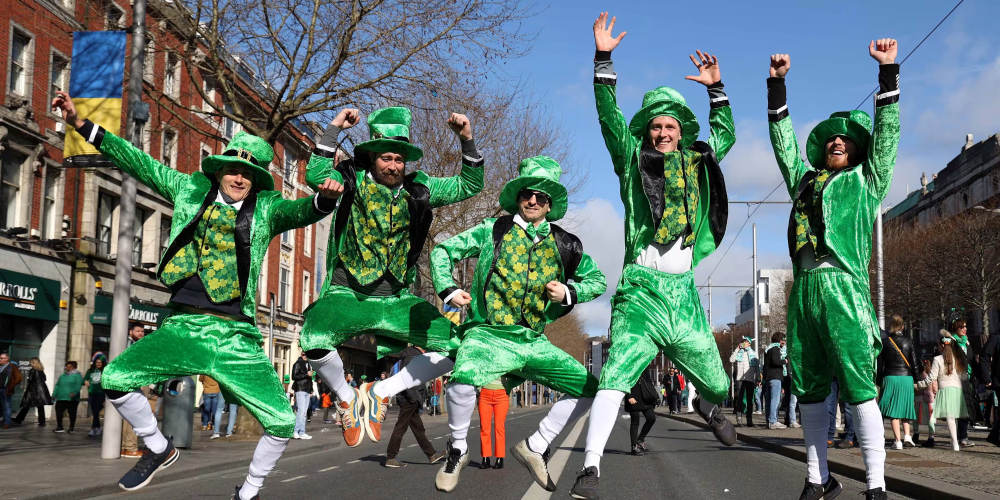
St. Patrick\'s Day, celebrated annually on March 17th,\ honors the patron saint of Ireland by marking the traditional anniversary of his death in the 5th century. Originally a modest religious feast day in Ireland, the celebration evolved into a global, secular holiday featuring parades, the color green, and Irish, largely driven by Irish immigrants in the United States.\
The Real Saint Patrick
- Origins:\ Born in Roman Britain as Maewyn Succat, he was not Irish.
- Enslavement \& Mission:\ Kidnapped at 16 and enslaved in Ireland, he later escaped, became a priest, and returned to Ireland in 432 CE to spread Christianity, according to\ Britannica\ and\ Georgia Public Broadcasting.
- Legacy:\ Legend credits him with driving snakes out of Ireland, though this is likely symbolic, notes\ Hotel Washington\ and\ YouTube.\
Evolution of Traditions
- From Religious to Secular:\ For centuries, it was a quiet religious holiday in Ireland where families attended church and lifted Lenten restrictions to eat and drink, says\ History.com.
- American Influence:\ Irish soldiers serving in the British Army held the first recorded St. Patrick\'s Day parade in New York City in 1762, notes\ History.com\ and Georgia Public Broadcasting.
- Corned Beef \& Cabbage:\ In the U.S., Irish immigrants substituted bacon with cheaper corned beef, turning it into a staple of the celebration, according to\ YouTube.
- Wearing Green:\ While associated with the \"Emerald Isle,\" green only became popular over time; it was initially linked to Irish nationalism, says\ Smithsonian Institution. It is also tied to the myth that wearing green makes you invisible to leprechauns, note\ Insight Vacations\ and\ YouTube.\
The Man:\ St. Patrick was a 5th-century missionary who is credited with bringing Christianity to Ireland. Interestingly, he was not Irish by birth but was born in Britain and brought to Ireland as a slave at age 16.
- The Date:\ March 17th is observed as the anniversary of his death.
- The Symbols:
- The Shamrock:\ Legend says St. Patrick used the three-leaf clover to explain the Holy Trinity (Father, Son, and Holy Spirit).
- The Color Green:\ While blue was originally associated with the saint, green became the hallmark of the holiday during the Irish Rebellion in 1798 as a symbol of national pride.
- Leprechauns:\ These mythical shoemakers from Irish folklore became synonymous with the day in the 20th century.
Modern Traditions \& Activities
You can structure your story around these popular ways people celebrate today:
- Wearing Green:\ It is a near-universal custom to wear green clothing or accessories to show spirit\—and to avoid being \"pinched\" by leprechauns.
- Grand Parades:\ The first recorded St. Patrick\’s Day parade actually took place in America (St. Augustine, Florida, in 1601). Today, massive parades in cities like New York, Chicago, and Boston feature bagpipes, dancers, and elaborate floats.
- Dyeing it Green:\ Some cities go all out, most famously Chicago, which dyes its river a vibrant emerald green every year.
- Family Fun:
- Leprechaun Traps:\ A popular activity for kids involves building creative traps to try and \"catch\" a leprechaun.
- Scavenger Hunts:\ Families often hide \"gold\" chocolate coins for children to find.
Traditional Festive Foods
Food is a central part of the celebration. You might include a scene featuring these dishes:
-
Corned Beef and Cabbage:\ Though actually an Irish-American innovation, this has become the \"standard\" meal for the holiday in the U.S..
-
Irish Soda Bread:\ A dense, crusty bread that is easy to make at home.
-
Colcannon:\ A comforting mix of mashed potatoes with kale or cabbage.
- Festive Treats:\ For a modern twist, many enjoy \"green\" foods like shamrock shakes,\ green pancakes, or green eggs and ham
.