
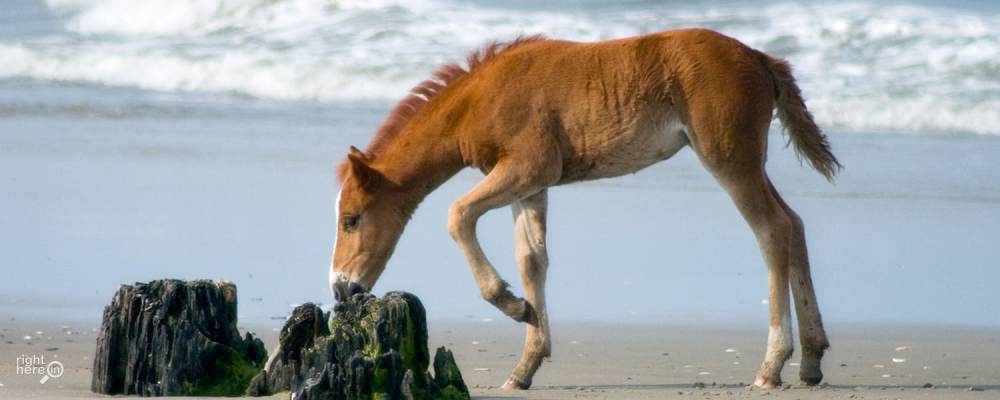
For 500 years, the most enduring residents of the Outer Banks, the Wild Colonial Spanish Mustangs, have called this island paradise home.
Until recent years, the Outer Banks of North Carolina were considered some of the most isolated and under-developed areas in the country. The banks consist of a string of sand dunes that serve to protect the mainland of North Carolina from the Atlantic Ocean. They are separated from the mainland by large bodies of water called sounds.
The Colonial Spanish Mustangs spotted along the beaches of Corolla are feral horses descended from a herd brought here by explorers as early as the 1520s, and they\’re recognized as the state horse of North Carolina.
Today, you\’ll find the largest herds of feral horses at the extreme ends of the Outer Banks. Corolla, to the north, and Shackleford Banks, the southernmost of the barrier-island chain, have herds of about 100 stallions, mares, and foals that call the beaches and dunes home. A smaller, more domesticated herd lives on Ocracoke Island.
How they got here is a bit of a mystery. It\’s said that some swam ashore from shipwrecks while others were castoffs of failed settlements, left to flourish on these untouched barrier islands for hundreds of years.
Adventurous visitors can get a close-up view of the horses by taking one of many guided tours offered at both Corolla and Shackleford Banks. Remember, the horses are wild animals and you should always maintain a safe distance of 50 feet. And while taking pictures of the horses is encouraged, feeding them is not.
The one thing any wild horse enthusiast should always bear in mind is to keep your distance. These horses look completely docile, and in most cases they are, but in actuality, they have been feral for hundreds of years and do not interact with the local human population. Never touch, approach, or feed the local horses \– like anything wild, they are best admired from a distance, and hopefully with a camera with a very good zoom lens. Feeding or encroaching within 50 feet of a wild horse is illegal and dangerous to both humans and the horses.
If you want to spot a wild horse along the beaches of the Outer Banks simply be patient. The horses can appear when you least expect it, either crossing your path on your first expedition or years after you\’ve vacationed on the islands. There are numerous tour companies that offer tours and can provide their knowledge of how and when to see the horses.\