
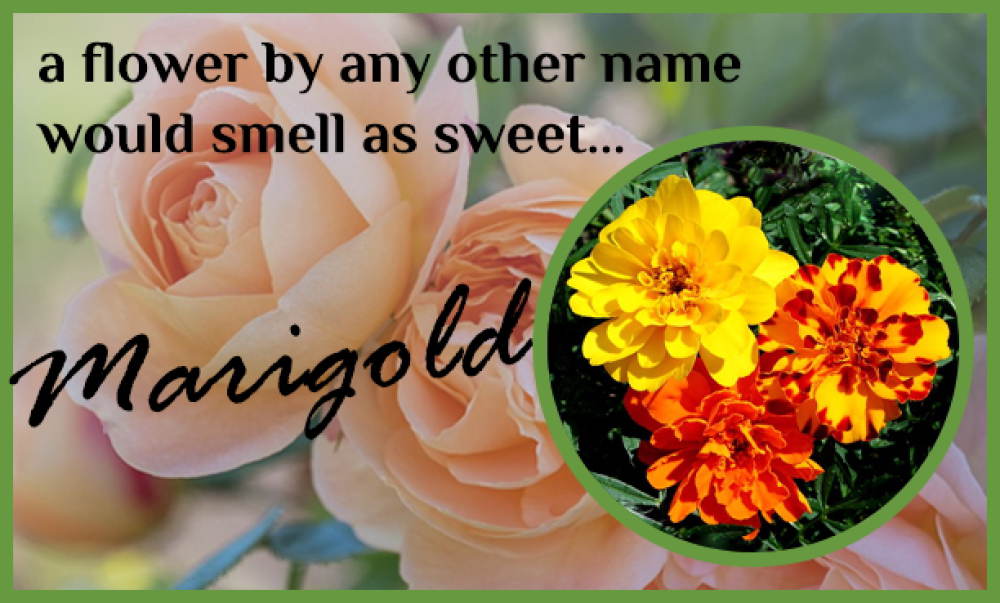
Next time you\'re gardening, remember you\'re planting a tribute to the Virgin. The familiar\ Marigold\ (Calendula officinalis) is called\ \“Mary\'s Gold\”.\ \ \
Medieval legend says that poor Christians who couldn\’t afford to bring gold coins as offerings to the Virgin Mary would bring these golden flowers instead. The name stuck, even if the history got a bit lost after the Reformation. It\'s a cool botanical reminder of how deeply she was woven into the daily life of our ancestors.
Marigolds are called \"Marigolds\"\ because the name is a shortened version of \"Mary\'s Gold,\" referencing their historical use in European religious traditions where peasants offered the golden flowers to the Virgin Mary, adorning altars and churches with them. The name stuck as these vibrant, golden blooms, often used in festivals and memorials, became widespread, with the\ Tagetes\ species (native to the Americas) eventually eclipsing the European\ Calendula\ (pot marigold) under the popular name.\
Key points on the name\'s origin:
- Religious Significance:\ Christians in medieval Europe used the bright, golden flowers for offerings to the Virgin Mary, calling them \"Mary\'s Gold\" or \"Mary\'s golden flower\".
- Shortened to Marigold:\ Over time, \"Mary\'s Gold\" was contracted into the single word, Marigold.
- Confusion with Calendula:\ The name was first applied to Calendula officinalis (pot marigold) but later transferred to the popular\ Tagetes\ species, brought from the Americas to Europe by Spanish explorers.
- Cultural Symbolism:\ The association with Mary\'s gold continued, even as marigolds became central to other traditions, like Mexico\'s Day of the Dead (Dia de los Muertos) and Indian festivals, where they symbolize remembrance and divinity.\
\