
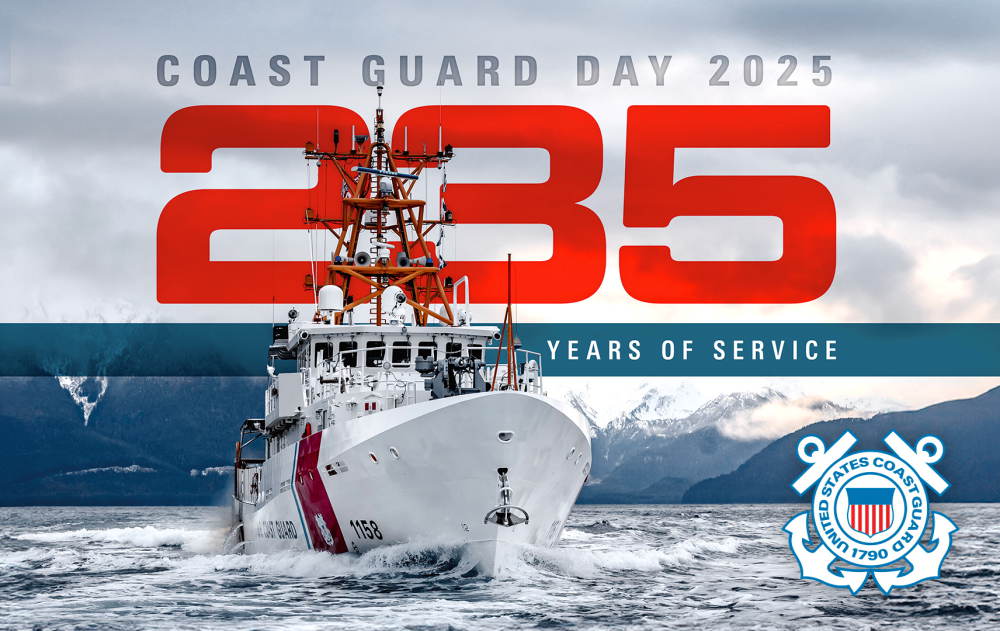
The Coast Guard saves people in trouble on the water and protects the country from maritime threats, promoting national security, border security and economic prosperity.
Whether they\'re protecting us on the high seas or performing heroic rescues after natural disasters,\ 2025, marks the Coast Guard\'s 235th anniversary. The Coast Guard was established in 1790 when President George Washington signed the Tariff Act, authorizing the construction of ten revenue cutters. These cutters were initially tasked with enforcing tariff and trade laws and preventing smuggling.\
President Woodrow Wilson signed the Coast Guard Act into law on Jan. 28, 1915, combining the Revenue Cutter Service with the United States Life-Saving Service to form the U.S. Coast Guard. This was the start of the service\'s maritime safety mission, which the Coast Guard continues today.\
In 1939, the Coast Guard assumed the responsibilities of the U.S. Lighthouse Service, and in 1942, it also assumed the responsibilities of the Bureau of Marine Inspection and Navigation.\
The Coast Guard Reserve was established in 1950 to support expanded port security responsibilities.\ In 1967, the Coast Guard moved from the Treasury Department to the Transportation Department, and in 2003, it moved to its current home, the Department of Homeland Security.\
New officers are trained at the U.S. Coast Guard Academy in New London, Connecticut, which was founded in 1876. Enlisted recruits train at the Coast Guard Training Center in Cape May, New Jersey, which was established in 1948.\
Today, the Coast Guard performs a host of responsibilities, including fisheries enforcement, icebreaking operations, marine environmental protection, aids to navigation safety, ensuring commercial ship safety, drug and migrant interdiction, military operations with the Navy, humanitarian operations and maritime security. \
The Coast Guard motto is \"semper paratus,\"\ which is Latin for Always Ready. It is also the title of the official Coast Guard marching song.