
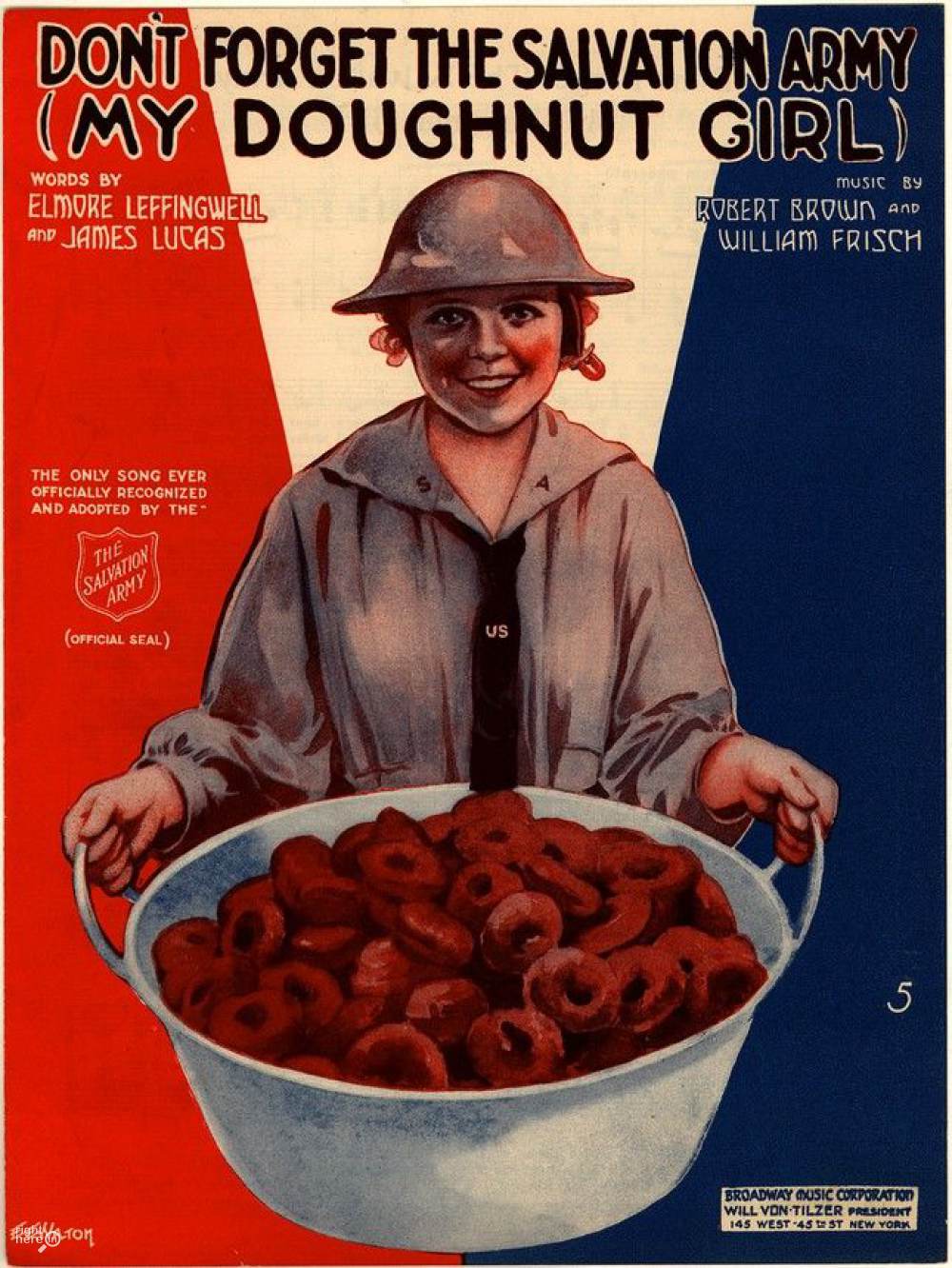
America loves donuts. We love donuts so much we have two National Donut Days in the calendar year, June 5th and November 5th. The one in November is dedicated to the women known as \“donut lassies\” who served treats and donuts to soldiers and veterans in World War I.\
You might think the donut is just a simple baked good. You would be wrong. The doughnut includes a convoluted past that involves Dutch immigrants, Russian exiles, French bakers, Irving Berlin, Clark Gable, and a certain number of Native Americans.\
Of course doughnuts in some form or other have been around so long that archaeologists keep turning up fossilized bits of what look like doughnuts in the middens of prehistoric Native American settlements. But the doughnut proper (if that\’s the right word) supposedly came to Manhattan, known then as New Amsterdam, under the unappetizing Dutch name of olykoeks\–\“oily cakes.\”
Fast-forward to the mid-19th century and Elizabeth Gregory, a New England ship captain\’s mother who made a wicked deep-fried dough that cleverly used her son\’s spice cargo of nutmeg and cinnamon, along with lemon rind. Some say she made it so son Hanson and his crew could store a pastry on long voyages, one that might help ward off scurvy and colds. In any case, Mrs. Gregory put hazelnuts or walnuts in the center, where the dough might not cook through, and in a literal-minded way called them doughnuts.
Her son always claimed credit for something less than that: putting the hole in the doughnut. Some cynical doughnut historians maintain that Captain Gregory did it to stint on ingredients, others that he thought the hole might make the whole easier to digest. Still, others say that he gave the doughnut its shape when, needing to keep both hands on the wheel in a storm, he skewered one of his mom\’s doughnuts on a spoke of his ship\’s wheel. In an interview with the Boston Post at the turn of the century, Captain Gregory tried to quell such rumors with his recollection of the moment 50 years before: using the top of a round tin pepper box, he said, he cut into the middle of a doughnut \“the first doughnut hole ever seen by mortal eyes.\”
But in fact, doughnuts didn\’t come into their own until World War I, when millions of homesick American doughboys met millions of doughnuts in the trenches of France. They were served up by women volunteers who even brought them to the front lines to give soldiers a tasty touch of home. When the doughboys came back from the war they had a natural craving for more doughnuts.
The first doughnut machine did not come along until 1920, in New York City, when Adolph Levitt, an enterprising refugee from czarist Russia, began selling fried doughnuts from his bakery. Hungry theater crowds pushed him to make a gadget that churned out the tasty rings faster, and he did.
Levitt\’s doughnut machine was the first sign that the doughnut, till then merely a taste sensation, could, in production, become a public spectacle. And so generations of kids like me, and adults, too, have stood transfixed by the Willy Wonka-like scene behind the glass of doughnut shops, learning in the process that the doughnut hole is built-in, not cut out. There before them, a circle of dough, shaped like a perfect smoke ring, and about the diameter of a baseball, dropped off into a vat of boiling oil, circulated, got turned over to brown on the other side, and emerged from the oil on a moving ramp, one by one like ducks in a row.
The Donut Invades America
By the 1930s, Adolph Levitt\’s machines were earning him a dreamy $25 million a year, mostly from wholesale deliveries to bakers around the country. \ By the 1934 World\’s Fair in Chicago, doughnuts were poster material, billed as \“the food hit of the Century of Progress.\” Seeing them produced \“automatically\” somehow made them part of the wave of the future. A doughnut cost less than a nickel, within reach of most of the Depression\’s victims.\

How North Carolina Changed Donuts
In 1937 young Vernon and two friends found themselves in Winston-Salem, North Carolina, with just $25 between them. They borrowed ingredients such as potatoes, sugar, and milk from a kindly grocer, stripped down to survive the heat of baking in July, and emerged with a fresh batch of Krispy Kremes, which they delivered in their 1936 Pontiac.\
The boys rented a building in what is now historic Old Salem in Winston-Salem, North Carolina, and began selling its Krispy Kreme doughnuts on July 13, 1937, to local grocery stores. The delicious scents of cooking doughnuts drifted into the streets, and passersby stopped to ask if they could buy hot doughnuts. So he cut a hole in an outside wall and started selling Original Glazed doughnuts directly to customers on the sidewalk.
By now there was a small chain of stores, mostly family-owned. They all used the Krispy Kreme recipe, but each store made its doughnuts from scratch. For Rudolph and Krispy Kreme, the results were always good, but not consistent enough. So Krispy Kreme built a mixing plant and developed a distribution system that delivered the perfect dry doughnuts mix to each Krispy Kreme store. Then Rudolph and his equipment engineers invented and built Krispy Kreme\’s own doughnut-making equipment. From the 1950s on, they focused on improving and automating the doughnut-making process.
During the 1960s, Krispy Kreme enjoyed steady growth throughout the southeast United States and began expanding outside of its traditional roots. The design of Krispy Kreme stores became consistent including the hallmark green tile roofs and heritage road signs. Vernon Rudolph died in 1973, and growth slowed as the company was reorganized for sale to Beatrice Foods Company in 1976.
In 1982, a small group of our early franchisees bought Krispy Kreme back from Beatrice Foods. A renewed focus on the hot doughnut experience became a priority for the company. They began to expand outside the southeast US and opened its first store in New York City in 1996. Soon afterward, in 1999, the first store in California opened and national expansion was well underway. When Krispy Kreme turned 60 years old in 1997, it was officially recognized as the 20th century American icon with a donation of company artifacts to the Smithsonian Institution\’s National Museum of American History. To date, nobody but Krispy Kreme has Joe LeBeau\’s secret recipe. That stays locked in a safe in Winston-Salem.