
Submitted by\ Willa Akins Adcock
The Peddler and the Peacock Pitcher
More than a century ago most southern towns were small, few and far between. The majority of stores only offered a limited number of items. For that reason, \“Southerners\” frequently learned to depend on peddlers who went throughout the country selling their wares. Peddlers were common from the late nineteenth century through the early twentieth century; many were of Syrian descent. These immigrants first arrived in the United States in large number in the 1880s. Often their source of livelihood was selling merchandise as they traveled. Sometimes they carried their goods on a wagon, but more often than not, they slung a pack over their backs with objects tied up inside and walked from farm to farm. \
There were peddlers went from door to door collecting old clothing and other items that could be mended for further use. Families often wanted to help people in need, and they would give discarded items to the travelers. In the process of procuring these items, the dealer with the bag would sell objects that people could use for their homes. Many of the products had been ordered from wholesale catalogues, so they had quite an assortment of trinkets and goods.
In the early part of the 20th century, there were many peddlers in and around the local area. The early salesmen filled the gap for those living in remote areas. They were usually a welcome sight as the residents would give them news that they could pass on to other families. Those on the farm like to hear what was going on with their far-flung neighbors.
In 1913 my mother, Annie Mae Adams, graduated from Cary Boarding Academy in Cary, NC. Within the next two years, she received her teacher\'s certification and began working in her local community. Her salary was $35 a month; it was eventually raised to $40.\ She thought this was a pretty good income at that time. Her teaching career lasted for eleven and \½ years.
At age 24, living at her parent\'s home some of those years, she saved most of what she earned; she did, however, spend a small amount of her salary on household items. Some of the first money that she spent from teaching was for a purchase from a peddler\—a peddler similar to the ones described above.
\ A particular dealer, who arrived carrying a pack on his back filled with interesting items, was one that my mother never forgot. He came on foot through the area to her parent\'s home which was located on what is today John Adams Road in Willow Spring. As she described this encounter, she stated that the peddler was precise in how he pulled the articles out of his large black bag. He displayed them on a table for her and her mother to admire. One by one he took each article out of his sack, and then he lifted the glass pieces to the window; he turned them around as the light picked up the colors. With a \"sleight-of-hand\" motion, the peddler used his fingers to point out the interesting combination of impressions or paintings on the objects. He was a real showman and quite cunning.
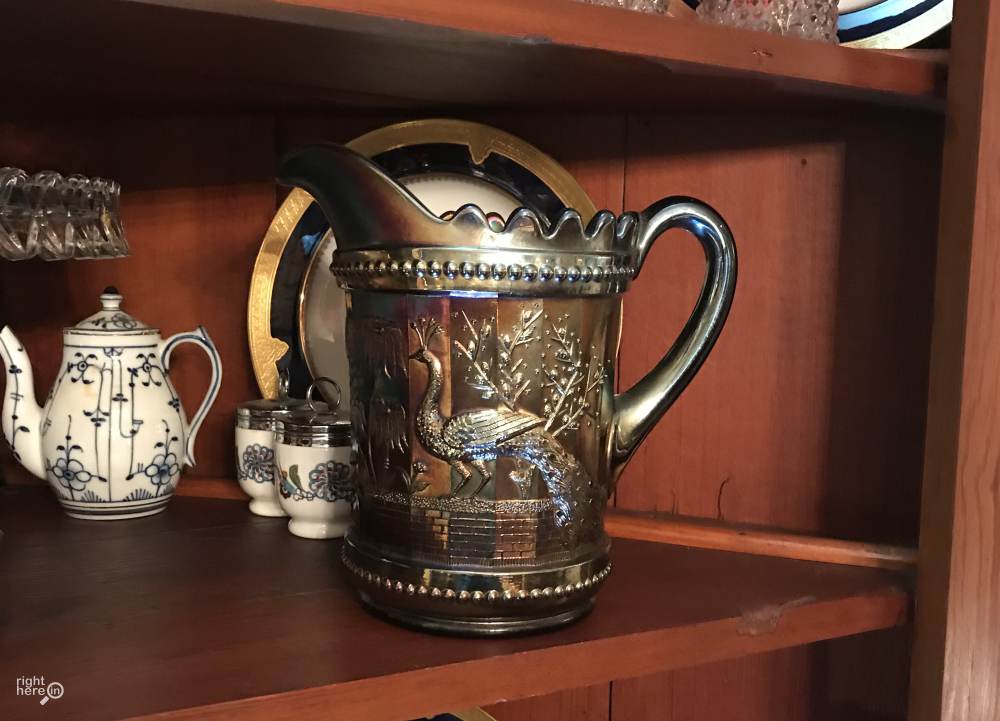
My mother became awestruck by a pitcher with a matching set of six glasses. The pattern on this elegant vessel was enhanced by the colors. There were two blue peacocks overlaid with purple in all their glory. They each had a long train of metallic green and gold feathers brilliantly discernible with raised spots that looked like eyes. This special pitcher, with these two peacocks, is what we would call \"Carnival Glass\" today. Vibrant and appealing, this complete set was priced at two dollars. \ After some haggling, the price was lowered to a dollar and eighty cents\—quite a large sum in 1915. But the dealer made his trade, and my mother was pleased with her purchase.
As I was growing up, the six glasses were missing, but this \“pleasing-to-the-eye\” pitcher had survived. My mother told me that she used the set many times for serving lemonade or water at ice-cream parties while entertaining her friends and beaus. But when I remember the pitcher, it was always displayed on the dining-room mantel---high enough to keep itchy fingers and curiosity seekers away. I never knew my mother to use the colorful old antique; it was just there over the fireplace perhaps to bring back memories of a time that was no more.
Today I sometimes place this same old pitcher atop a chest or cupboard to enjoy its beauty, but never have I used it for its original design. In arranging flowers, I have let it take the place of a vase but not very often. The peacock pitcher that the \"sleight-of-hand\" peddler sold in 1915 has become a family keepsake. It takes me back to the stories my mother, always the teacher, loved to tell.\
Wouldn\'t it be interesting to know what became of the fascinating showman of a hundred years ago? If we desire God\'s blessings, each of us must find and commit ourselves to God\'s map regardless of where He takes us on life\'s highway.
Luke 8:16 \“No man, when he hath lighted a candle, covers it with a vessel, but setteth it on a candlestick, that they may see the light.\” KJV \ \ \ \ \ \ \ \ \ \ \ \ \ \ \ \ \ \ \ \ \ \ \ \ \ \ \ \ \ \ \ \ \ \ \ \ \ \