
If you\’re an animal lover, keeping your pet safe is probably one of your highest priorities. But, unlike humans, you can\’t simply tell your furry friends to stay away from anything that could harm them and expect them to understand.
Pet safety is a big responsibility for pet owners. There could be many threats to your pet lurking in your home. You need to know what those threats are to keep your animals safe.
In this guide, we tell you about the household chemicals, objects, plants, and decorations that could be dangerous to your animals.
If you think your animal has ingested poison, you can call the\ ASPCA Animal Poison Control Center\ at 1-888-426-4435. In addition to helpful information, the ASPCA also offers insurance plans that cover several pet health problems.
12 biggest dangers to pets at home
It\’s essential for pet parents to know what household dangers they should keep their animals away from. In the next few sections, we show you some threats to your pet that might be in your home.
Cleaning products and toxic items
Some cleaning products and chemicals can hurt your pet\’s health. For example, if your animal ingests cleaning substances with bleach, this might cause issues like vomiting, upset stomach, or breathing problems. Certain detergents can have phenols that can be toxic to animals.
Medications
Your human medication may help you, but it can harm your pets. Prescription and over-the-counter (OTC) drugs and supplements like ibuprofen, naproxen, acetaminophen, vitamins, and diet pills can cause issues like breathing difficulty and kidney failure in animals. Store your medicine in a high or pet-proof cabinet where it can\’t be reached.
Toys
If you\’ve ever had to\ childproof your home, you know small items\—like toy pieces\—can be choking hazards for children. Toy parts can also be choking hazards for pets. Eating them may cause pets to develop blockages in their digestive systems that require surgery. Clean up your kids\’ toys so your pets can\’t chew or swallow them.
Food and drinks
It can be difficult to resist your pet\’s cute little face when they\’re begging for your scraps, but you need to be careful about which food you let them ingest. Many foods humans love can be dangerous for animals to eat.
Pits and seeds \— like those found in apricots and peaches \— can get caught in your animal\’s esophagus or intestines and result in a blockage. Some seeds, like cherry and apple seeds, even contain traces of cyanide that can poison an animal in large enough doses. Grapes and raisins have tartaric acid that can cause potentially life-threatening issues.
Different beverages can also be risky for your animals. The caffeine in coffee and soda can give an animal an elevated heart rate or even cause seizures in high doses. Alcohol can also be very difficult for many pets to metabolize and can cause low body temperature and respiratory problems.
Some other dangerous foods for pets include chocolate, garlic, macadamia nuts, raw potatoes, onions, yeast dough, and sugar-free candy with xylitol.
You might be surprised to learn that certain bones can also be dangerous to animals. Cooked bones, like those in rotisserie chickens, can have pieces that splinter off and get stuck in or puncture your pet\’s throat. Rawhide bones, like those bought in pet stores, can sometimes have the same issue.
Places they can fall or get trapped
There are many places in your home where your pets can fall or get trapped. Your dog might get stuck under your fence. Your cat might get stuck in the area behind your refrigerator or couch. Animals can also slip and fall down the stairs in your home or into holes in your backyard.
Holiday decorations
Many of your holiday decorations can be dangerous to pets. For example, Christmas bulb ornaments can break into sharp pieces, and plants like holly and mistletoe are toxic to animals if ingested. Do your best to\ make sure your potentially harmful decorations are out of reach\ or off limits to your animals.
String products
Items like tinsel, ribbon, and polyester cobwebs are also popular holiday decorations that can harm pets. String products can get tangled in your pet\’s esophagus or intestinal tract, causing life-threatening blockages that require surgery.
Electrical cords and components
Puppies (and many other pets) like to chew. Take steps to restrict your pet\’s access to electrical cords, so they don\’t get electrocuted. It might not be possible to hide all the cords in your home, but you can use cord covers to reduce the risk of your pet puncturing them.
Plastic bags and products
Plastic is just as dangerous to animals as it is to humans. Items like plastic bags can get wrapped around an animal\’s head and cause them to suffocate. When ingested, bits of plastic can restrict a pet\’s breathing and require veterinary care to remove.
Batteries
In addition to being choking hazards, batteries contain sulfuric acid. If your pet chews a battery, causing it to rupture, it can result in painful chemical burns to the animal\’s mouth or insides.
Plants
There are various household plants that can be poisonous to pets. Here\’s a rundown of a few of the most dangerous types of greenery for your pets to eat.
- Lilies\ can cause all sorts of heart, organ, and digestive problems in animals. In fact, cats that consume certain types of lilies, like lily of the valley flowers, can get severe kidney failure in as little as a few days.
- Consuming\ azaleas\ can be life-threatening for pets. The flower can upset an animal\’s intestinal walls, put the animal in a coma, and cause heart problems.
- Plants like\ rhubarb\ and\ shamrock\ can cause liver failure.
- Several plants like\ chrysanthemums,\ pothos,\ corn plants,\ oleander, and\ hibiscus\ can irritate an animal\’s intestines.
- Some\ mushrooms\ can damage your pet\'s organs, like their liver.
- Eating\ poinsettias\ can make pets extremely sick and cause vomiting.
- Tulips\ can cause serious digestive issues for dogs and cats alike.
Garbage
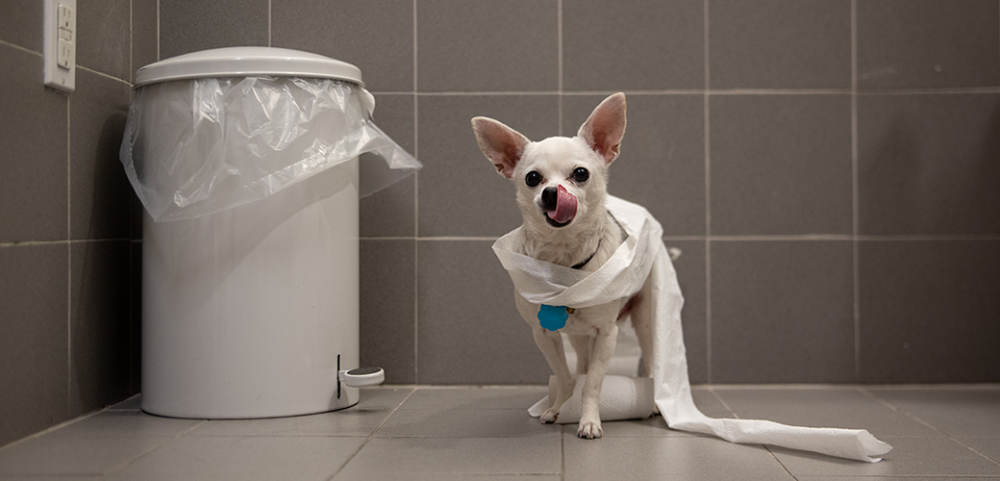
Keeping your pets from rooting in the garbage might be challenging, especially if you have large dogs. Still, it\’s essential if you want to keep them from ingesting potentially dangerous particles and scraps of food that have been thrown away.
One of the best ways to keep your dogs out of the trash is by training them. Try to catch your dogs in the act when they try to rummage through your trash and let out an emphatic \“No!\”
When you see your dog going toward the trash can, you can also try blocking their way with your body to show them the garbage is off limits.
Some products can help keep your pets out of the trash too. You might try using a childproof trash can your pet can\’t open or buy a can with a snug lid that is small enough to fit in your pantry or cupboard.