
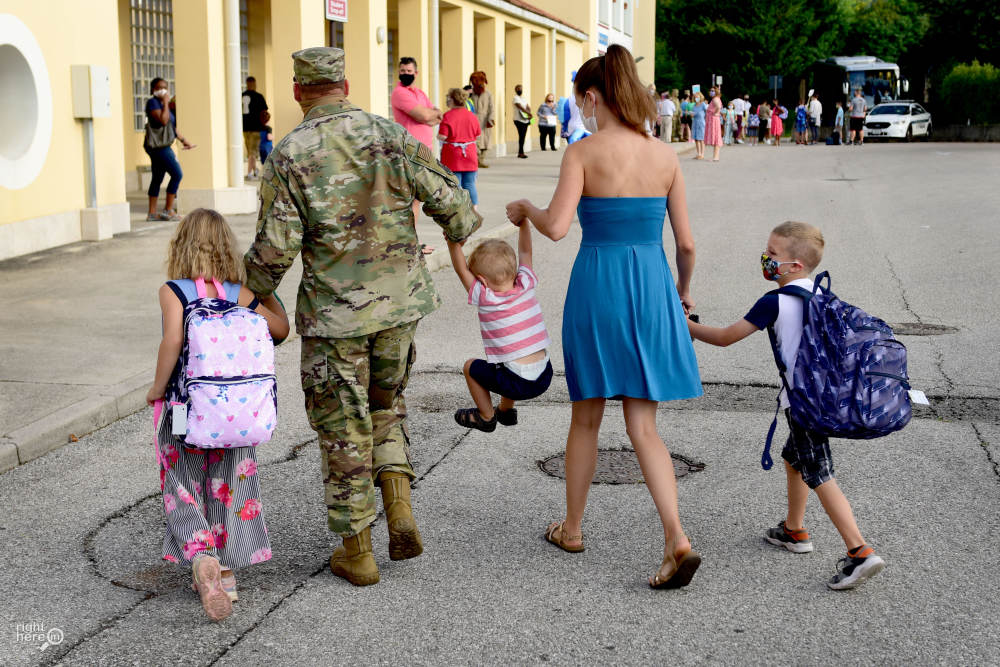
Resilience, Mental Health and Education as Military Children Head to School in the Midst of COVID-19
Life as a military child comes with its own set of challenges. Through it all, USO locations provide a sense of continuity for military children \— no matter where they are in the world. So even during the pandemic, we have renewed our efforts and are now offering more online programming \— like virtual field trips and scavenger hunts \— to keep kids happy, supported and connected.\ \
The life of a military child is one of constant change. A military childhood means that you are uprooted, sometimes with very little warning, and moved across the country \– or even the world \– every two to three years. It\’s a life of always being the new kid, always finding your way through a new school, always feeling like you don\’t belong. It is a childhood where nothing \– not the four walls of your house, the location of your classroom or the presence of your military parent \– is guaranteed.
But resiliency is often synonymous with being a military child, and from a young age, American military kids quickly learn how to persevere through even the most challenging of situations. However, they still need our support, especially when tackling this year\’s COVID-19 pandemic and a return to an uncertain school situation.
What Does Life as a Military Child Today Look Like?
According to the Department of Defense (DoD), 37.3% of active duty service members are parents to the roughly 1 million military children living around the world. Although their parents are the ones who wear the uniform, military children, who account for over half of the active-duty U.S. military family community, serve and sacrifice in their own ways. From coping with a parent\’s deployment, to living overseas in a foreign country, to having a digital-only connection to family members living far away, today\’s military children must grapple with a unique set of challenges in addition to the typical stressors of being a kid.
Every fall, one of the most common challenges facing many U.S. military children is starting at a new school after a summer of PCSing (i.e., moving) with their family to a new location. Military children typically move every two to four years (more than three times the national average), which means they are constantly having to make new friends, adapt to new environments and adjust to new schools.
Constant Moves and Starting Over at School Can Take a Toll on Military Children
When it comes to their education, only about 71,000 military children around the world attend one of the 161 DoD schools located around the world, which are run by the Department of Defense Education Activity (DoDEA). This means that the majority of military children attend civilian schools, where the military-civilian divide can be especially apparent, or are home-schooled, where military children can sometimes feel isolated from their local communities.
On average, military kids will attend up to nine different schools before they graduate high school because of frequent relocations. Sometimes, these moves happen fast and unexpectedly, leaving little time for children to find closure, fully process what is happening or even just say goodbye to their friends. This constant change of schools, teachers, friends and learning environments can be a significant stressor for military children and their families, particularly when combined with other realities of military life and normal childhood worries.
How the USO Supports Military Children and Their Families
One of the biggest challenges of life as a military child is constantly having to start over, which can lead to feeling unsettled, or a lack of sense of belonging.
The USO and cartoonists have come together to create coloring sheets for military children, to help them navigate the stress of the coronavirus pandemic through art.\
To counteract those feelings, it is important to maintain some continuity in their life, such as through extracurricular activities, military base celebrations or the consistent involvement of military support organizations like the USO. In fact, a 2018 interview series found that the USO was the support organization most talked about by the participants who experienced an overseas move as a military child.
No matter where their moves take them, USO centers around the country and the world are a constant in the lives of military children. Whether they are in Virginia or Japan, a military child can walk through the doors of their local USO and be greeted with that familiar red, white and blue logo, comfy couches, games, movies and snacks. For many military children \– and their families \– USO centers serve as a safe haven when everything else in their lives has changed.
The USO also ensures that military children can stay connected to their military parent even during deployments. The Bob Hope Legacy Reading Program is incredibly popular among service members and military children alike. Through the program, service members film themselves reading a book and send the recording to their children back home. The children also receive a copy of the book in the mail, so they can read along with the recording. This program is especially popular with younger military children, who may struggle to understand where or why their parent has gone.
The USO also provides programs specifically geared towards military kids, to support the youngest members of our military community and to make them feel seen and appreciated. Whether it\’s a designated snack hour event just for them or a visit from an NFL star while they\’re stationed far from home in South Korea, USO programs and events are there for military children every step of the way.
\