
Submitted by Willa Akins Adcock
During World War II there was in place a program called War Emergency Tenant Protection Act or \"Rent Control\".\ Rent Control can be defined as government regulations that limit landlords\' ability to set and increase rents freely on residential properties.\ It placed limits on the amount of money a landlord could charge for a rental unit.\ Most rental ceilings came into being at the end of WWII.\ It was to help in the rental housing market due to the demands of veterans returning from overseas service at the end of the war\ in 1945.
In addition to limiting the amount of rent increases a landlord could impose on a tenant, Rent Control officers often regulated or prohibited the practice of collecting nonrefundable deposits and limited the ability of landlords to evict tenants.
I recently ran across some papers and old letters that my mother, Annie Mae Adams Akins, had written in 1944, 45 and 52.\ She was always careful to be fair and to comply with the rules of the Rent Control Board. \ She never wanted to overcharge, and she waited after the war far longer than necessary to raise any rents.\ In all the years that she was in the rental business, I never knew her to require a deposit from anyone.\ Many of her tenants stayed with her fifteen or more years; some later built homes of their own; she was always proud and happy for them when they did.
Some time before 1929, she saw a need for affordable rental property in the area.\ She felt a calling to become involved in this business as a profession.\ She hired Mr. V. I. Smith, builder of the area, to begin construction on the foundation for a house in Varina.\ The foundation was almost complete when the Great Depression became a reality.
Mother lost what money she was counting on for this building project when The Commercial Bank of Raleigh closed its doors forever.\ She had saved the money from her years of teaching school in the Willow Spring and Angier areas.\ She had planned to use this money for building, but had to abandon the project due to the onset of the Depression.\ In the meantime her father, John \"Quint\" Adams of Willow Spring, left her a small tobacco farm.
Mother saw this farm as a way to continue her desire to provide rental housing.\ With that in mind, she would get Mrs. Audry Weeks Oliver to help by driving her down to the farm; mother did not drive.\ The farm was located on the south-west side of Mt. Pleasant Church in Willow Spring.\ They both would help with the housing of the tobacco crop.\ Mother handed leaves while Mrs. Oliver, wife of Lawyer Oliver, looped, or tied the tobacco onto the tobacco sticks.\ Mother did this to insure that the crop would be profitable and to motivate and encourage the farmer who was in charge of the farm.\ This continued from the late thirties through World War II.\ Since many of the young men were away fighting, it was often hard to secure enough help to house the barns of tobacco for curing.\ Mother saw their help as a way to save the crop.
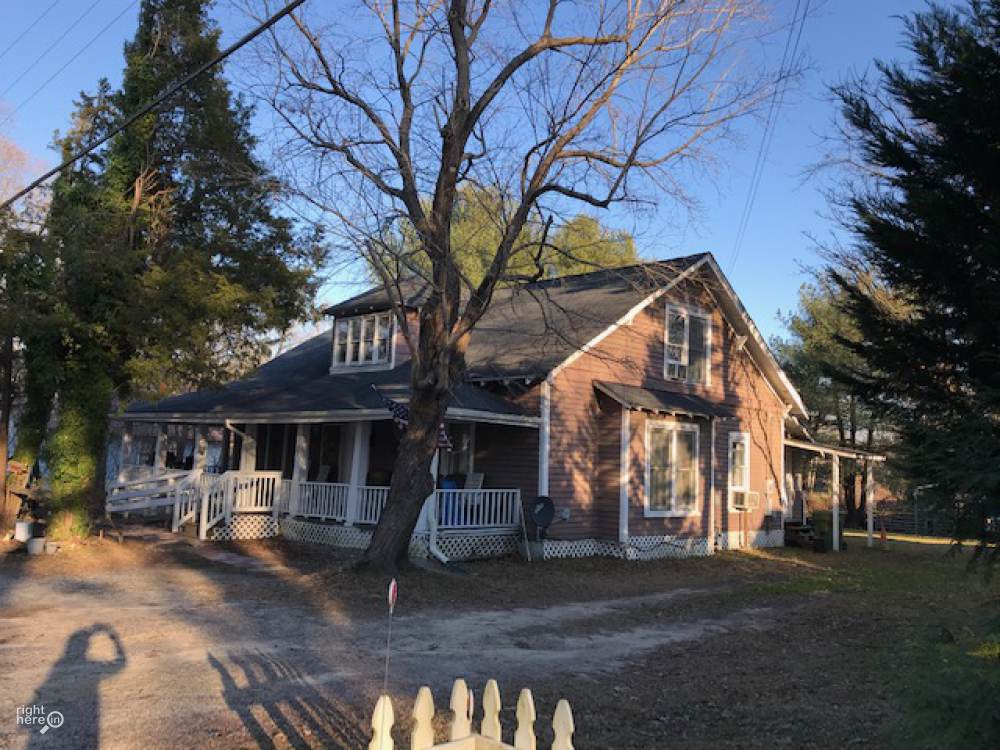
\ Nine years after the foundation for the first house had been started, mother felt she could call Mr. Smith back to continue the building project.\ Late in 1938 the foundation that had stood vacant all those years was finally completed, and the first house was built.\ This began mother\'s involvement with the public in the rental business.
As a result of the loss of the money at the closing of The Commercial Bank, mother was always very careful how she spent her money.\ And she knew that others had also lost money and were suffering from the results of the depression as well. \ Sympathizing with those who were looking for a house to rent, she wanted to keep her rents low.\ She never wanted to overcharge or ask for deposits that people in those days simply did not have.\ Below is a letter that she wrote in 1952:
Dear Mr. Lewis:
More than eight years ago I rented a house in Varina on Blalock Street to Mrs. Jones for $15.00 per month.\ After some time, Mrs. Jones sub-rented three rooms to a gentleman, and she then paid $16.00 per month.\ She was paying $16.00 per month when the house was registered with the O.P. A. as an apartment house.
After Mrs. Jones took in the third family, the O. P. A. allowed me to raise the rent to $18.00 per month.\
At present there is only the Jones family in the house.\ Mrs. Jones does not want to rent any more rooms.\ She wishes to occupy the whole house; she now has a grown daughter living with her.
I am sending a new registration for this house, naming it a one-family house.\ I am also sending a petition asking for a 20% raise above the original price for the house when it was rented to one family.
It is a two story, seven room house.\ I just had the outside painted with two coats of paint.\ The rent is lower than comparable rent in Fuquay-Varina.
I am asking that the rent be raised from $15.00 to $18.00 per month as a one\–family house.
Respectfully,
Annie M. Akins
\
Rent Control was discontinued soon after this letter, in 1952, was written.\ My mother, however, persisted in the rental business for 33 more years making a total of 45 years in this profession.
\"God is love; and he who abides in love abides in God and God in him.\"\ 1John 4:16
\