
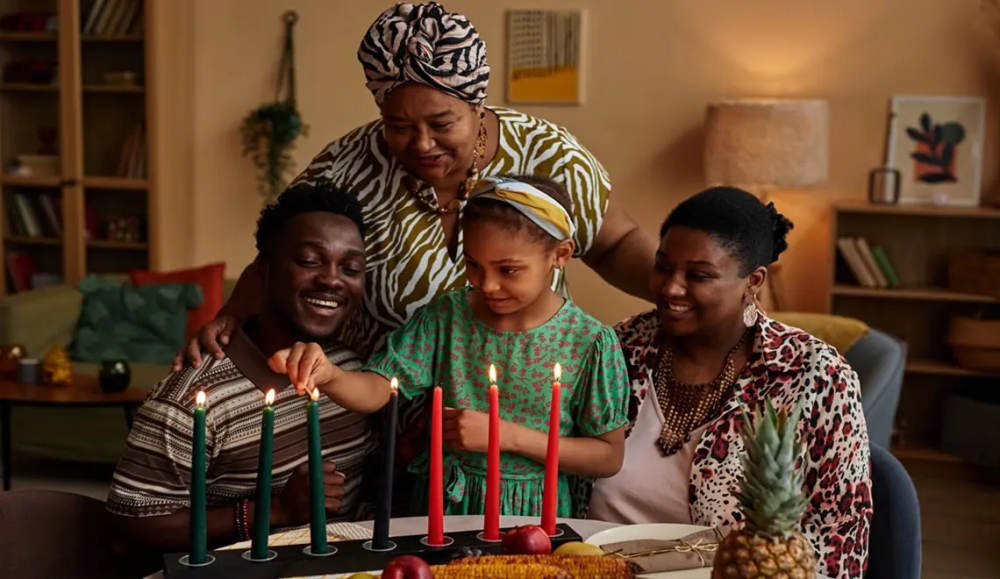
A week long non religious holiday that celebrates African American heritage and is celebrated by people of all faiths.\ \ We start with Umoja,\ or unity,\ the principle that asks Black people to strive for and maintain unity.\
Kwanzaa is observed for seven days, and there is a different value for each day:\ On each night, a candle is lighted to observe the nguzo saba, the seven principles of Kwanzaa:
- Umoja (unity),
- Kujichagulia (self-determination),
- Ujima (collective work and responsibility),
- Ujamaa (cooperative economics),
- Nia (purpose),
- Kuumba (creativity)
- Imani (faith).
The candles include one black, three red and three green. The colors red, black and green are important to Pan-Africanists. Black represents \“the people,\” while red is for the blood spilled in the struggle for liberation, and green for the future of Black liberation.
Kwanzaa is a secular holiday: The holiday draws influence from a variety of African cultures and practices.\
Kwanzaa is open to people of other cultures: There\’s a common misconception that Kwanzaa is closed to non-Black people because of its roots. However, according to the official Kwanzaa website, anyone is welcome to celebrate the holiday, comparing it to other cultural holidays.
It is often celebrated alongside Christmas:\ In the holiday\’s early years, it was frowned on to celebrate Kwanzaa and Christmas. But as it became more popular, participants began to observe both holidays. \“We definitely had to come to terms with Kwanzaa,\” Celeste Morris told the New York Times in 1990. \“It was easier when the kids were younger because they didn\’t really grasp the full meaning of the holidays. As they got older, they wanted Christmas. Kwanzaa was good food; Christmas was toys.\” Still, the official Kwanzaa website urges families to not mix Kwanzaa with Christmas symbols because it contradicts the principle of kujichagulia.
Kwanzaa\’s dates weren\’t chosen because of Christmas or Hanukkah, according to Karenga:\ Although Kwanzaa is often observed with Christmas and shares a candle lighting ceremony with Hanukkah, Karenga said the dates have a different origin.\