
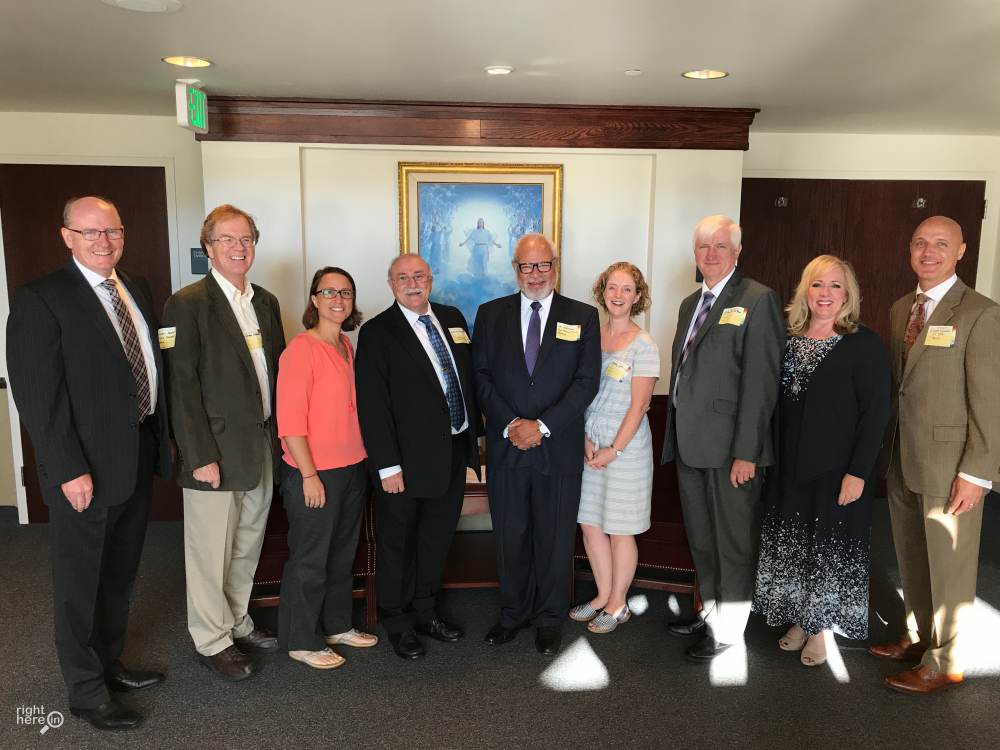
Photo: L-R Steve Bodhaine, Reverend Hickle, Catherine Preston, Jihad Shawwa, Dr. Dumas A. Harshaw, Jr., Dr. Christy Lohr Sapp, Elder J. Vaun McArthur, Julia A. Fellows, William Calhoun
CHURCH SOUTHEAST REGIONAL CONFERENCE HOSTS INTERFAITH PANEL IN APEX
PANEL DISCUSSES INTERFAITH UNITY THROUGH DIVERSITY or EFFECTIVE INTERFAITH EFFORTS SUBJECT of LOCAL PANEL
Unity through diversity was among the themes discussed by a panel of interfaith Triangle leaders in Apex.\ The discussion was moderated by William Calhoun, Director of Public Affairs for the Raleigh North Carolina Coordinating Council of The Church of Jesus Christ of Latter-day Saints, as part of a day-long regional meeting.
The distinguished panelists were Dr. Dumas A. Harshaw, Jr., Pastor, First Baptist Church, Raleigh; Dr. Christy Lohr Sapp, Associate Dean for Religious Life, Duke University Chapel; Reverend Steve Hickle (retired), United Methodist Church; Jihad Shawwa, Raleigh Muslim Community; Catherine Preston, Campus Minister for Faith Development, Duke Catholic Center.
Themes important to current societal needs and concerns were discussed.\ The importance of an interfaith linking of arms to address these concerns was acknowledged by the panel.
To the questions, \“Is interfaith effort important and, does it matter?\” Mr. Shawwa responded, \“In America we have to know one another.\”\ \“Our number one enemy is ignorance, in not knowing one another.\”\ Ms. Preston stated that it is important to learn humility through learning and engaging despite diversity. \ \ \ \ \ \ \ \ \ \ \ \ \ \ \ \ \ \ \ \ \ \ \ \ \ \ \ \ \ \ \ \ \ \ \ \ \ \ \ \ \ \ \ \ \ \ \ \ \ \
Dr. Lohr Sapp made the point that inter-religious literacy, inter-religious service doing good together and inter-faith friendship is at the heart of the spirit of humility. Reverend Hickle then posed the question, \“Why are we not at home enough in our own faith to be comfortable with other faiths? He then said that we need to expect the best of others and find a goal that is compelling like addressing world hunger in which to work together.\ He named Rise Against Hunger as just such a vehicle for collaborative service crossing faith boundaries.
Answering that same question, Dr. Harshaw said that we need to live without assumptions so we can enter into a dialogue with others.\ He suggested we forget our own traditions when engaged in dialogue with others so we can learn and accept others and lower our defenses.\
Ms. Preston agreed that fostering unity is what leads to a fellowship with others.\ The idea of understanding your own faith before you seek to speak with others; sharing with and respecting other faiths was raised by Mr. Shawwa. Engagement by serving with others and learning of others\’ faiths, traditions and communities was called for by Dr. Lohr Sapp.
The moderator, Mr. Calhoun, sought the panel\’s suggestions for practical interfaith interactions because, he said, the beauty of interfaith interactions is to open doors for love, family and a vital sense of community. Dr. Harshaw added that \“Conversation and reciprocity are important to build community.\” He also said that we need to reach across faith and traditions in peace and non-violence as encouraged by the Martin Luther King Committee enabling the power of love to overcome hate.
All panelists agreed that bringing faith traditions together, providing others with opportunities to pray together and speak with others not of your own community was important. \ Mr. Calhoun pointedly asked the panelists what can the Latter-day Saints specifically do to build community and help others who are minorities?
\ Interestingly, Dr. Lohr Sapp answered by saying she felt that if Latter-day Saints would speak of commonalities like a similar hardship or past persecutions, a shared sense of history would be generated. She related that contrition is also a part of interfaith dialogue.
Reverend Hickle recommended that Fear of the Other: No Fear in Love by Bishop Will Willimon be read and that, in his experience, it would help one examine one\’s own perspective on the understanding of the importance of dialogue across faith and community.
The desire to create the dialogue that Reverend Hickle speaks of was the reason behind Mr. Calhoun\’s putting the panel together for this Annual LDS Public Affairs Meeting. The Southeast Region of the Church is comprised of five states and 16 different zones within those states.
\ The leader of the Apex Stake (a local geographical area comprised of several individual congregations), Steve Bodhaine, addressed the meeting and said that the LDS Church wants to build community bridges so that they can support faith, protect family and defend religious freedom. He mentioned that ReligiousFreedom.lds.org is a site that supports these important values and can contribute to creating interfaith dialogue as well. \ In a fitting end to the panel discussion, Mr. Shawwa said, \“At the end of the day, we are a community of Americans!\”
It is the hope of all those that participated, that more discussions like this can take place in all of our communities fostering unity despite diversity.
For more information contact: Maggie Elliott Gross, Assistant Director Public Affairs, mme144@ldspublicaffairs.org, 919-410-6279