
Submitted by Willa Akins Adcock
Fuquay-Varina\’s First Manufacturing Co.\ \ \ \ \
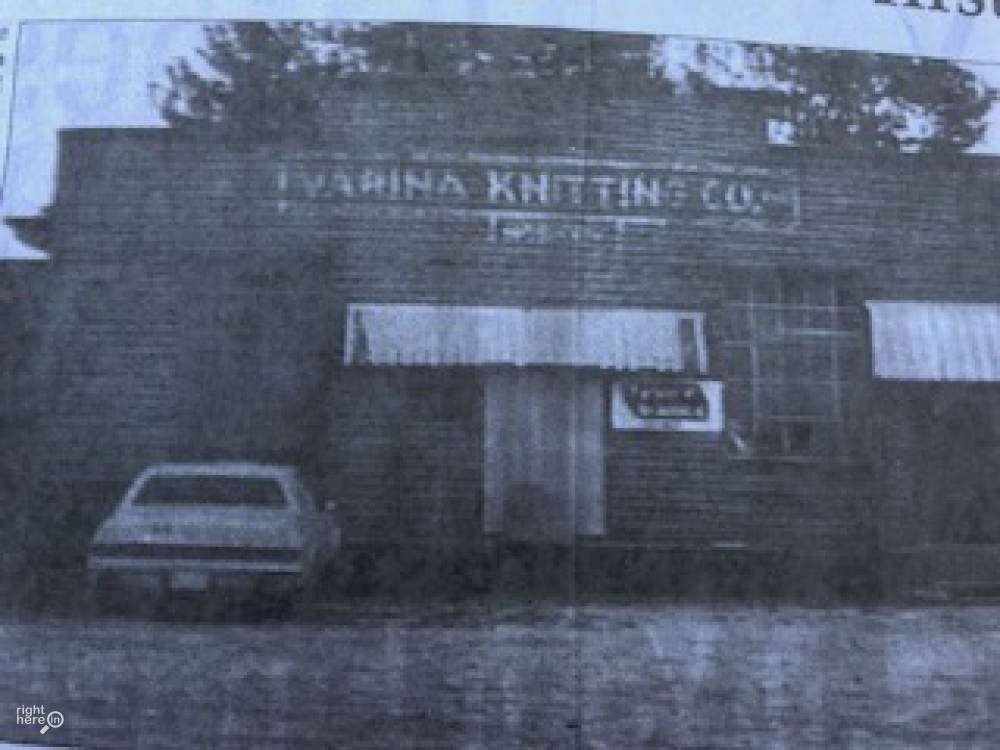
At the age of 9 or 10 years old, growing up in the Varina section of town on E. Broad Street, I had a friend who lived on E. Faucette Street across what is now Hwy. E 401. We would leave notes to each other in the hollow of a pine tree growing on the edge of an abandoned railroad bed where a track had once been.\ This tree was in front of the VARINA KNITTING CO.\ At that time the knitting company was busy making socks and hosiery for men and women in World War II.
There wasn\’t a lot of traffic then, so I didn\’t have to worry too much about crossing Hwy. 15-A at the time. (Now Hwy. 401) My friend, Barbara, and I exchanged notes at this tree until we each got a phone after the war. \ When I was in front of the KNITTING CO. taking my notes to Barbara, I always wondered what it was like inside the building.\ I had heard something about knitting socks and that sounded interesting.

Mr. Harold Parker of Thomasville, NC attended Duke University where he met Edith Judd, daughter of Dr. James \“Jim\” Mahlon Judd, of the area.\ In 1927 the two Duke students were married.\ They lived in Thomasville for a short while before returning to Varina; Edith\’s home town. \
Harold Parker, whose experience was in manufacturing, decided to build a mill in Varina, a community next door to the town of Fuquay Springs at the time.\ He first set up a plant in Holly Springs until the land he wanted in the Varina section became available. \ After a year or so, he was able to buy the land he needed and began building an outstanding brick structure for its day.\ Early in 1933 this building began operating as the VARINA KNITTING COMPANY.
The plant worked two shifts of a total of about 40 workers.\ Fred Ragan, who was originally from Durham and had experience in mill work, moved to the area.\ He had been hired as foreman of the local mill and set up a home in the Varina section on North Street. \ \ Also hired as overseers were Charlie Ray Williams and Ralph Crabtree.
The Parker mill was making men\’s socks under the brand label Parva.\ J.B. Lynch Co. handled sales, and this merchandise was available all over the U. S. \ \ Sacks 5th Avenue provided their own labels for the mill to place on their purchases. \ There was a big price difference, as you might expect, with the Sacks label compared to the Parva label.
Employees known as \“Knitters\” ran the machine that produced the basic socks.\ Some employees\’ jobs were to pull items from the flow of merchandise that came out with loose or broken threads and mend these particular socks.\ The other items then moved to another room where each piece was placed on an aluminum form with holes in it; these socks were steamed into shape.\ The \“foot wear\” then would be bundled together, and packages were divided into three sizes.\
The work at the mill was exposed to major changes when the United States became involved in WWII.\ The government was then in charge of the operations of the Knitting Co.\ During war time, it produced socks and heavy ribbed women\’s hosiery for the military.\ Shipping then was sent to many other places.
Once WWll was over, Mr. Parker wanted to get back into production for civilian sales of the now popular \“argyle socks\” that had become the new style in men\’s hosiery after the war.\ But the mill owner soon found that the cost of replacing the knitting equipment with new machines to produce the argyle design would cost a total of $750,000.\ Even so he thought he might go ahead with the plan.\ But soon he was presented with another type of endeavor.
In 1944 Mr. Harold Parker\’s brother-in-law, James Judd, owner of a furniture store on Broad Street in Varina, wanted to get out of the furniture business.\ He offered the store in exchange for some other property that Mr. Parker owned.\ With the acquisition of the Varina furniture store, and the building of Parker\’s Furniture on Main Street in Fuquay, Mr. Parker had his hands full.
Charles Parker, the Parker\’s oldest son was only in high school at the time, and it would be a long while before he would have sons who could help with the running of the mill.\ Since the change to the argyle socks would require different machinery, Mr. Parker felt that it was a good time to cease production at the VARINA KNITTING CO.

The mill closed in 1953, and the machinery was sold.\ Sometime later, one of Mr. Parker\’s sons, Jimmy, had a Print Shop in a front office section of the building.\ Another son, Gerald, had a Photo Processing Shop on the other side.\ The building still stands off HWY 401 E just before \“R. J\’s Place\”.\ It was a fine constructed building, and for that reason, it has weathered the years quite well.
Appendage:\ Thanks to Charles, Gerald, and Jimmy Parker, sons of Mr. Harold Parker, who gave information for this article.
Isaiah 52:7 How beautiful on the mountain are the \“feet\” of those who bring good news, and proclaim salvation, who say to Zion, \“Your God reigns!\”
\
\