
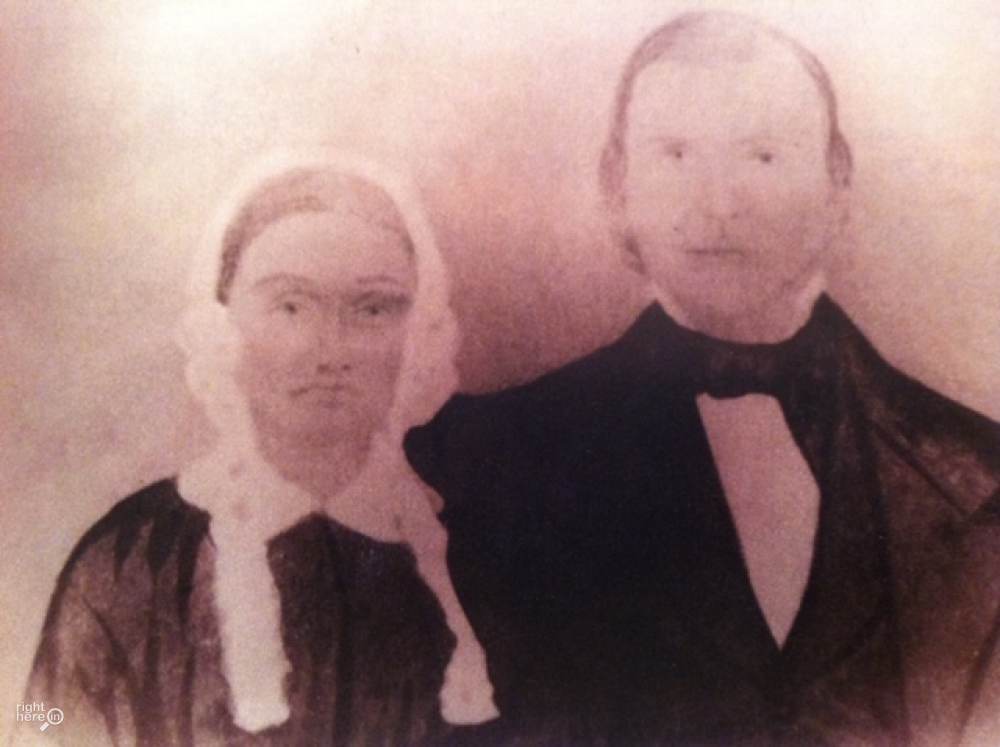
Submitted by\ Willa Akins Adcock
William \"Bill\" Blalock and his sister, Annie Eliza Blalock (Who later married John Quinton Adams) give us a picture of the aftermath of the Civil War. It is told here
by Annie Eliza\'s daughter, Annie Mae Adams Akins. This article was taken from a tape made in January 1985 just nine months before Annie Mae died at age 94.

Bill Blalock was born in 1853 and died in 1935. His sister, Annie Eliza Blalock Adams, was born in 1856 and died in 1943. They were children of Hugh and Christiana Blalock of Willow Spring. Bill was 12 and Annie Eliza was 9 years old when Sherman\'s army came through the country in the spring of 1865.


Bill and his sister and their family had heard that the Union troops would soon be coming on Old Stage Road from Clemons (Clayton) on their way to Raleigh from Bentonville. Gen. Joseph E. Johnston had met and been defeated by Gen. William T. Sherman\'s army. Sherman had 60,000 troops; Johnston had 20,000. Johnston\'s troops withdrew to Smithfield; Sherman\'s went on to Goldsboro. Later on April 26, 1865 Johnston surrenders to Sherman at Bennett Place near Durham.

The Hugh Blalock home was about a half mile off Old Stage Road and what is today Hwy. 42E. Stories had preceded the troops about how they destroyed everything that might help the South continue fighting. The Blalock family had heard how soldiers had burned cross-ties and bent the rails from the tracks around trees; they understood they set fires to the split-rail fences used for keeping the animals corralled. They were alarmed, but began preparing for their arrival.
Bill and his sister, Annie Eliza, and the other seven siblings, along with their parents, got busy with the help of a few trusted slaves. They began hiding all the goods that they thought the soldiers would burn or carry away. There was an older slave, Atlas, whom they trusted with hiding some of the special things--all except Grandpa Hugh\'s gold; that he buried himself.
The horses were put in a low meadow beyond the creek; the cows in the reed swamp beyond the pasture. Bill had a colt that he loved and was training. He took
extra care to hide him well so he would not be taken. His brothers buried the cured hams, sausage, and other meat. They hid all the produce they had grown: potatoes, dried apples, nuts, dried peas and beans and the canned vegetables. They even hid the chickens.
When Sherman\'s army arrived, the soldiers went immediately to Atlas, the older slave. They told him they were his friends and had come to free him along with the other slaves. They knew word of their advancing had preceded them, and they were aware that the people had concealed their belongings. The soldiers
asked Atlas to show them where everything was hidden. Atlas, being the faithful servant that he was, refused to tell them anything, but there was a much younger slave, Alexander, who was eager to oblige. They convinced him they were his friends.
Alexander, young and afraid, did as they said: led them to the horses, showed them where the meat and the produce was buried, and eventually led them to Bill\'s colt. Some things they burned, others they took with them. Along with the wagons and road carts, they took all the horses and mules, and Bill\'s colt.
When the soldiers had plundered and gathered all they wanted at Grandpa Blalock\’s home, they went to him, sitting on the front porch watching all the proceedings. One of the soldiers walked up to him and put a revolver to his head.
He said, \"Alexander tells me you have some gold; and have buried it. Tell me where it is, or I am going to shoot you. Grandpa Hugh said, \"Shoot, I am just as ready to die as I will ever be.\"
Remarkably, the soldier did not shoot. He put his gun away, and with some of the other soldiers went into the house to plunder what they could find there. They took feather beds from the home; they took my grandmother Christiana\'s hand-knit gloves. She told the soldiers she had taken a lot of time knitting those gloves; she would like to keep them. They paid no attention.
After rummaging through the house and property and hanging around for a couple of days, the troops left with the wagons and go-carts loaded. They tied the feather-bed covers to the wagons and split the ticking so the \"goose down\"\ would be forced out. The soldiers celebrated by hollowing as they went down the road racing. All the while the feathers were drifting out and up. It looked as if it were snowing. The feathers, from the comforters, floated up into the air and slowly drifted downward; scattered by the wind over the near-by fields. They were never to be gathered again! A picture of what was happening to a way of life in the \"Old South\".
Mourning the loss of his beloved colt, Bill set out to overtake the soldiers. As the troops traveled up Old Stage Road with the horses and other stolen goods, Bill kept up a steady pace begging them to give him back his colt. They ignore him as they advanced toward Swift Creek; traveling the remainder of the day with Bill at their heels. About nightfall, Bill became more insistent; pleading with them in a desperate fashion. The soldiers tired, and especially tired of Bill and his whining, finally relented and told Bill to take his colt and go.
Bill was ecstatic! He jumped on his little horse and rode like the wind, yet looking back, afraid that the soldiers might change their minds. No one could have been happier on that homeward-bound journey. Bill came back to a shaken family; fearing for his\'s life at the hands of the rampaging soldiers, and fear for what the future held for all the family after all the destruction. But they were indeed happy that Bill was home with his beloved colt.
After the troops arrived in Raleigh, the regiments were said to look like \"a wave of the ocean\" as they marched in perfect formation up Fayetteville Street. The Blalock family heard how a Confederate soldier, Lt. Walsh of the 11 th Calvary from Texas, shot into Sherman\'s army as they paraded; I don\'t think he killed anyone\—maybe wounded a couple. He tried to escape, but barricades had been set up, and the horse he was riding could not get through. He was captured at Crabtree Creek. The order was given for him to be taken out and hanged where
the ladies wouldn\’t see it. He was later buried at Oakwood Cemetery. With such stories rampant, the Blalock family realized how fortunate they were that none of their family was treated similarly.
When my mother, Annie Eliza, was older, she told that the year after the Union troops came through Willow Spring was the hardest year they ever endured. They had neither mules nor horses for plowing. The family could only plant what the brothers were able to cultivate by pulling the plows themselves. Sherman\'s men had mistakenly left behind some cows that they didn\’t find in the reed swamp. They practically lived off milk and butter from those few cows. In addition, they had some wheat flour and some dried beans they had saved for planting. Times were extremely harsh, but by the second year, conditions began to slowly improve. They were able to plant a cotton crop, a vegetable garden, and replace some of the horses. They started over with some semblance of a normal life again.
Atlas, the older slave, who had been so faithful during the time Sherman\'s men were rampaging, begged to stay there on the farm after all the slaves had been freed. Annie Eliza\'s parents, Hugh and Christiana Blalock, felt privileged to have him. Atlas remained and worked there until his death. He was loved and respected until the end and was buried there on the farm.

The Blalock home still stands along Hwy. 42E of Willow Spring.