
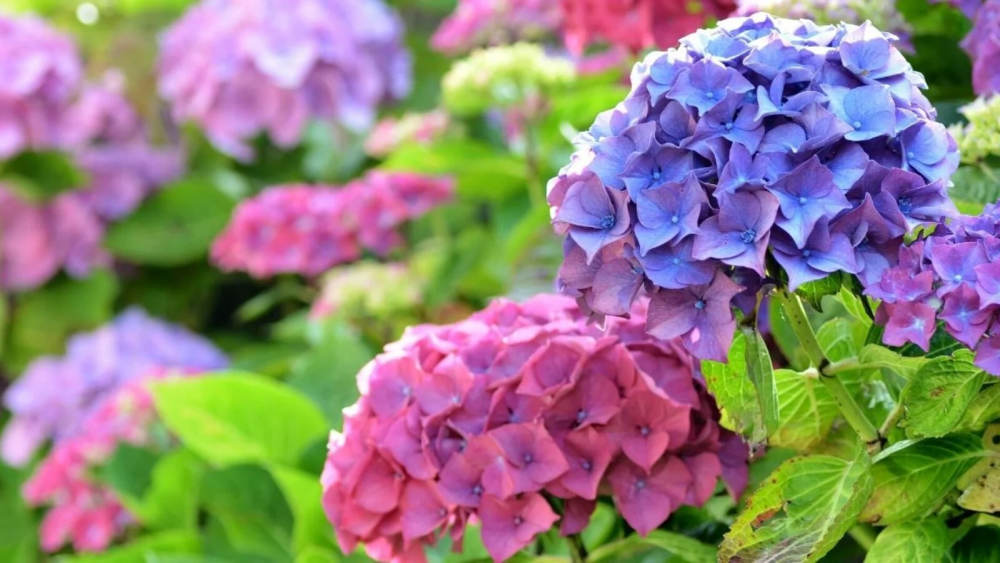
Use these tips to make your hydrangeas bloom beautifully throughout the summer and into fall.\ \ Most gardeners plant a hydrangea shrub for one reason, those big, showy flowers. But how do you make sure your\ hydrangea\ flowers bloom? The right amount of water, light, and fertilizer are key, but it\'s also vital to know what type of hydrangea you\'re growing as each has slightly different preferences. Follow these general care recommendations as well as tips for the most popular hydrangea varieties are panicle, smooth, and bigleaf and get ready to watch your hydrangea flowers bloom and multiply.
Tips for Planting Hydrangeas
Setting your hydrangea shrub up for success at planting time will encourage a healthy, well-blooming plant. Site it based on your particular hydrangea\'s light preferences\—depending on the variety, they can handle part shade to full sun. In a spot with\ well-draining soil, dig a hole that\'s twice as wide and about as deep as your hydrangea\'s nursery pot; amend with compost for a nutritional boost and cover soil with mulch to retain water. When planting your hydrangea, it\'s best to\ water it\ at least three times a week to establish a strong root system.
8 Outstanding Hydrangeas from the Better Homes \& Gardens Test Garden
How Often to Water Hydrangeas
Regardless of the variety, all hydrangeas love water. (Their\ name comes from the Greek\ hydra\ meaning \"water.\") But how much water do hydrangeas need? You\'ll know by looking at the leaves.\ Hydrangea leaves droop\ when the plant is too dry, telling you they need water. The leaves also go limp in the midday heat, so wait until evening to see if they recover before you water them. Be sure to keep the soil moist but not soggy.
Fertilizing Hydrangeas
Fertilizing hydrangeas can be a tricky task. Most hydrangeas don\'t need much, but woody plant authority Michael Dirr, a retired University of Georgia horticulture professor, says the\ best fertilizer\ for hydrangeas is an all-purpose plant food applied in late winter or early spring before hydrangea start producing flowers (depending on the variety, most hydrangeas start blooming in June or July). Be careful when applying hydrangea fertilizer: If you give your plants too much, you might get more leaves than blooms.\ Too much nitrogen\ also produces long stems that might not set flower buds.
\
How to Get More Panicle Hydrangea Flowers:
- Plant panicle hydrangeas in\ all-day sun or afternoon sun.
- Water them during a drought, especially if you notice wilting.
- Add plenty of organic matter (such as compost) around the plant.
- Limit any drastic pruning to early spring, just before new growth emerges.
How to Get More Smooth Hydrangea Flowers:
- Plant smooth hydrangeas in full sun if the soil stays moist. (Partial shade is better in spots that dry out from time to time.)
- Water them during times of drought, especially during the heat of summer.
- Amend the soil with organic matter (such as compost).
- Prune stems back in early spring, just before new growth emerges.
How to Get More Bigleaf Hydrangea Flowers:
- Plant bigleaf hydrangeas in half-day sun in average soil; full sun in areas with cool summers and consistently moist soil.
- Water them well in spring and early summer; it\'s okay to let them be a bit drier from late summer to early autumn.
- Amend the soil with organic matter (such as compost) every year.
- Don\'t prune unless necessary (except to cut out dead/diseased branches). Limit pruning of varieties that bloom on only old wood to late June and early August.
- Give the stems extra winter protection by wrapping them in burlap and insulating with shredded leaves.
- Keep good air space between the plants; don\'t crowd them together or against other plants.
- Don\'t give bigleaf hydrangeas too much love; water, fertilizer, etc., they may devote all their foliage to leaves instead of blooms.